See more
(ML)
DESIGN DIRECTOR
Tokyo, Japan (JST)
00
:
00
:
00
AM
Menu
Close
(Introduction)
Digital product teams have never been faster. Cloud platforms, mature component ecosystems, and AI-assisted development have reduced the cost of shipping software that appears, at first glance, modern. And yet a familiar post-mortem question is becoming increasingly common: we shipped, we modernized, we improved the surface — why do users still fail to choose us, and why do the numbers remain stubborn?

The frustration is understandable. Many teams assume that visual coherence and functional completeness will naturally translate into adoption, retention, and pricing power. A refresh can certainly restore credibility and reduce friction, but sustainable advantage rarely comes from aesthetics or features alone. It comes from what the product means to users, and whether that meaning is proven and felt consistently across every interaction.

This is where most organizations miscalculate. They treat product and brand as sequential disciplines: build first, then align later through messaging, identity, and tone. In practice, brand is not a downstream layer applied after the fact. It is a constraint system — the set of expectations a product repeatedly creates and fulfills. When those expectations are not engineered into the product itself, teams ship output without compounding equity. They produce releases rather than reinforcement, and the market responds with indifference masked as consideration.

The PRIME Helix, a framework developed using my personal experience and knowledge, addresses this gap by treating Product Logic and Brand Soul as a unified operating system, integrated across five levels with explicit contracts that make alignment testable rather than aspirational. It provides a structured method for ensuring that what a product does and what it stands for are not merely compatible but mutually reinforcing at every layer of decision-making.
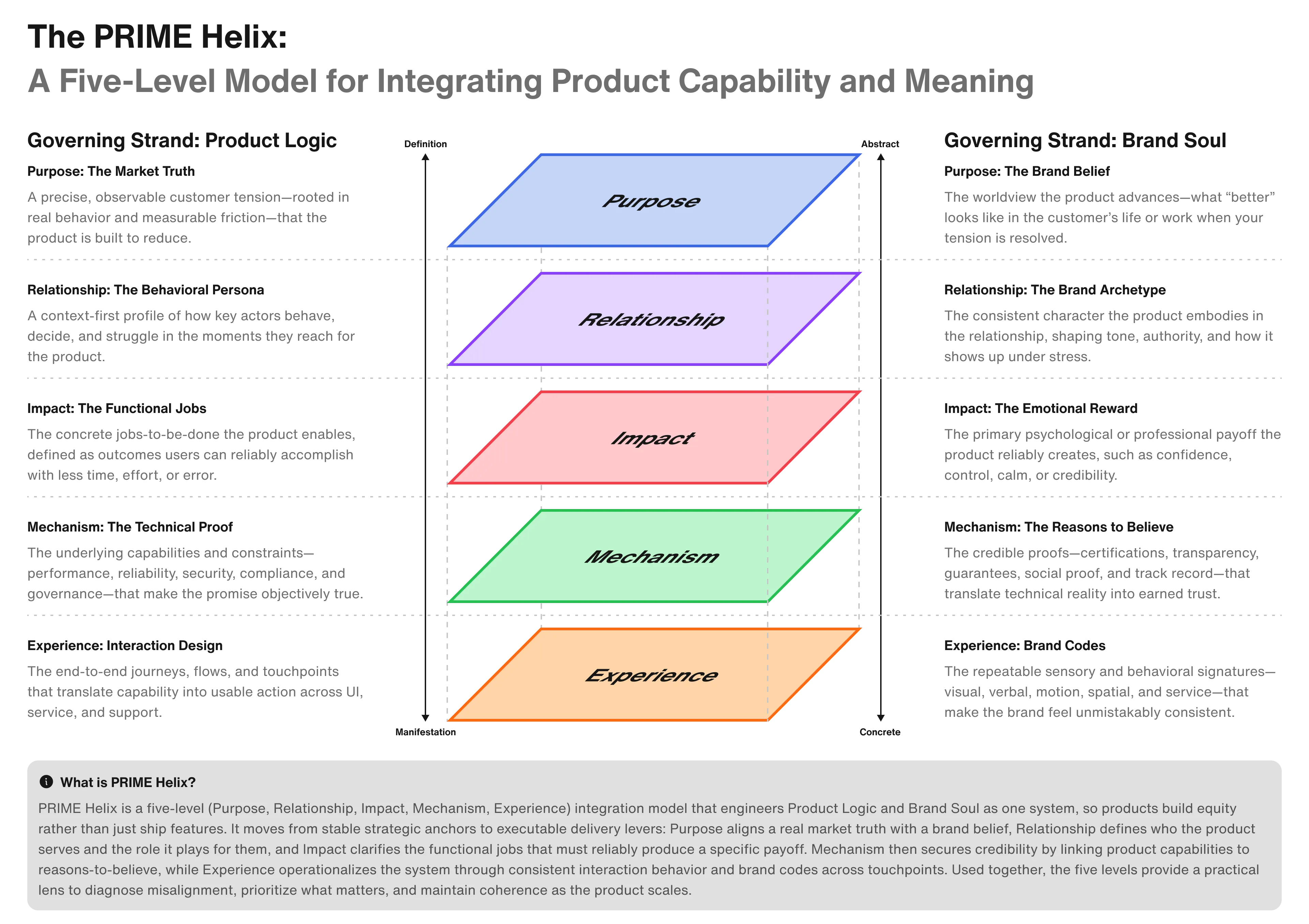
PRIME Helix synthesizes the five levels into one integration model that links product capability and brand meaning from strategy through execution.
(The Architecture of PRIME: Five Levels, Two Strands, One System)
PRIME is a five-level integration model for building brand-led products: products that are not merely functional, but memorable, trusted, and preferred over time. The model contains two strands that must be bound at each level. Product Logic describes what the product must do to be useful, reliable, and adoptable — the domain of capabilities, workflows, and technical systems. Brand Soul describes what the product stands for and the outcomes it consistently enables — the domain of meaning, stance, and perceptual equity.

At each level, PRIME defines an integration contract: an explicit bridge between capability and meaning. When the bridge holds, the product accumulates equity with every interaction. When the bridge breaks, the product may still ship and may even function well, but it becomes interchangeable. Users can articulate what it does but struggle to explain why it matters, and preference erodes into price sensitivity.

The five levels move from stable anchors to iterative delivery surfaces, arranged hierarchically to reflect their relative stability and governance role. Purpose defines strategic direction and sets boundaries on what the organization is willing to build. Relationship defines the product's stance in the user's life or work and clarifies who it serves. Impact defines the value exchange and articulates what outcomes the product enables. Mechanism defines credibility by specifying how claims are proven, and trust is earned. Experience defines behavior across touchpoints and determines whether meaning is confirmed or contradicted in the moments users remember.

This structure is deliberate. Higher levels are more durable and change less frequently, while lower levels are more responsive to market feedback and competitive dynamics. Purpose may evolve every few years; Experience may iterate every sprint. But at each level, the integration contract ensures that execution remains tethered to intent, and that brand is not decoration but design logic embedded in the product itself.
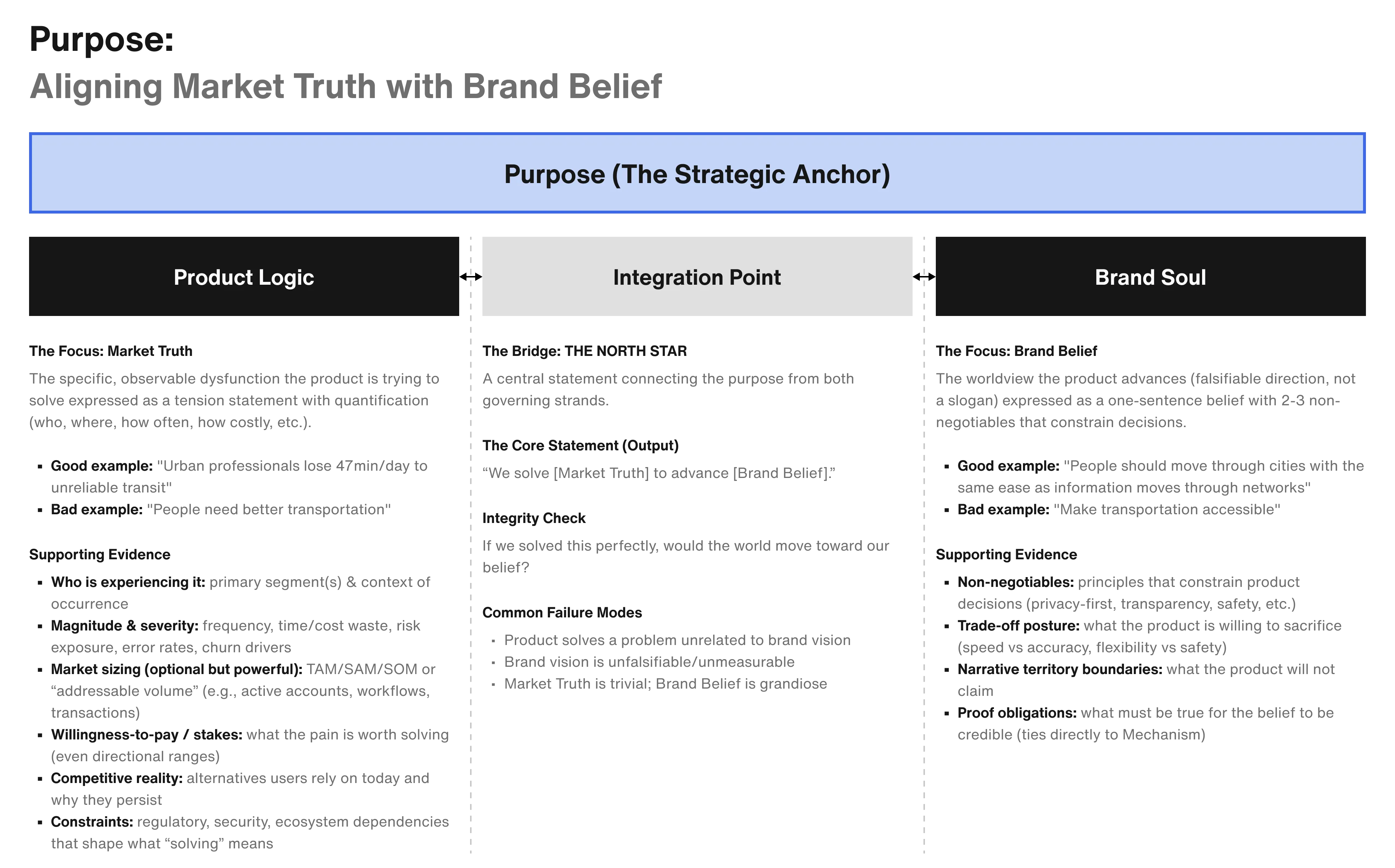
Purpose aligns a quantified market tension with a falsifiable brand belief to establish a shared North Star and constrain downstream decisions.
(Purpose: The Strategic Anchor)
Purpose is where brand-led product begins because it governs what the organization is willing to build — and what it must be willing to refuse. Without this anchor, roadmaps expand into feature factories responding to every request, and differentiation quietly decays into parity as teams chase completeness over compounding.

On the Product Logic side, Purpose starts with a precise Market Truth: an observable dysfunction the product reduces or eliminates. In digital products, tensions tend to be concrete rather than aspirational. Common examples include unreliability that disrupts workflows, trust deficits that slow adoption, compliance burdens that consume resources, coordination costs that fragment teams, cognitive overload that degrades decision quality, or latency risks that introduce operational anxiety. The discipline here is specificity. A tension is not a broad category like "inefficiency" but a falsifiable claim about friction that exists in the world today.

On the Brand Soul side, Purpose is expressed as a Brand Belief: the change in behavior, norms, or expectations that the product is advancing. This is not a statement of the company's internal values, but a claim about how the world should work differently if the product succeeds. A security platform might champion the belief that protection should never require sacrificing speed. A collaboration tool might advance the belief that remote work should feel more intentional than proximity ever was. The belief is the lens through which product decisions are evaluated for strategic coherence.

The integration contract at this level is the North Star. It is not a slogan designed for external communication. It is a decision filter designed for internal governance. It binds tension to belief in a single governing sentence and imposes a strict test: if we solved this tension perfectly, would we meaningfully advance the belief we claim to champion? When that answer is yes, Purpose becomes an instrument for principled trade-offs, allowing teams to decline features that create value but dilute meaning. When the answer is no, the organization is either solving problems unrelated to its stated belief or claiming beliefs unrelated to the problems it actually addresses — both of which erode credibility rather than build it.

Without a tight North Star, roadmaps do not fail dramatically. They drift quietly — one reasonable request at a time — until no single feature can explain what the product is actually for.

This level also establishes the boundaries of acceptable scope. If a requested capability falls outside the North Star's logic, it may still be necessary for competitive parity or contractual reasons, but it should be treated as a defensive investment rather than a source of differentiation. The test prevents scope creep from becoming strategy drift.
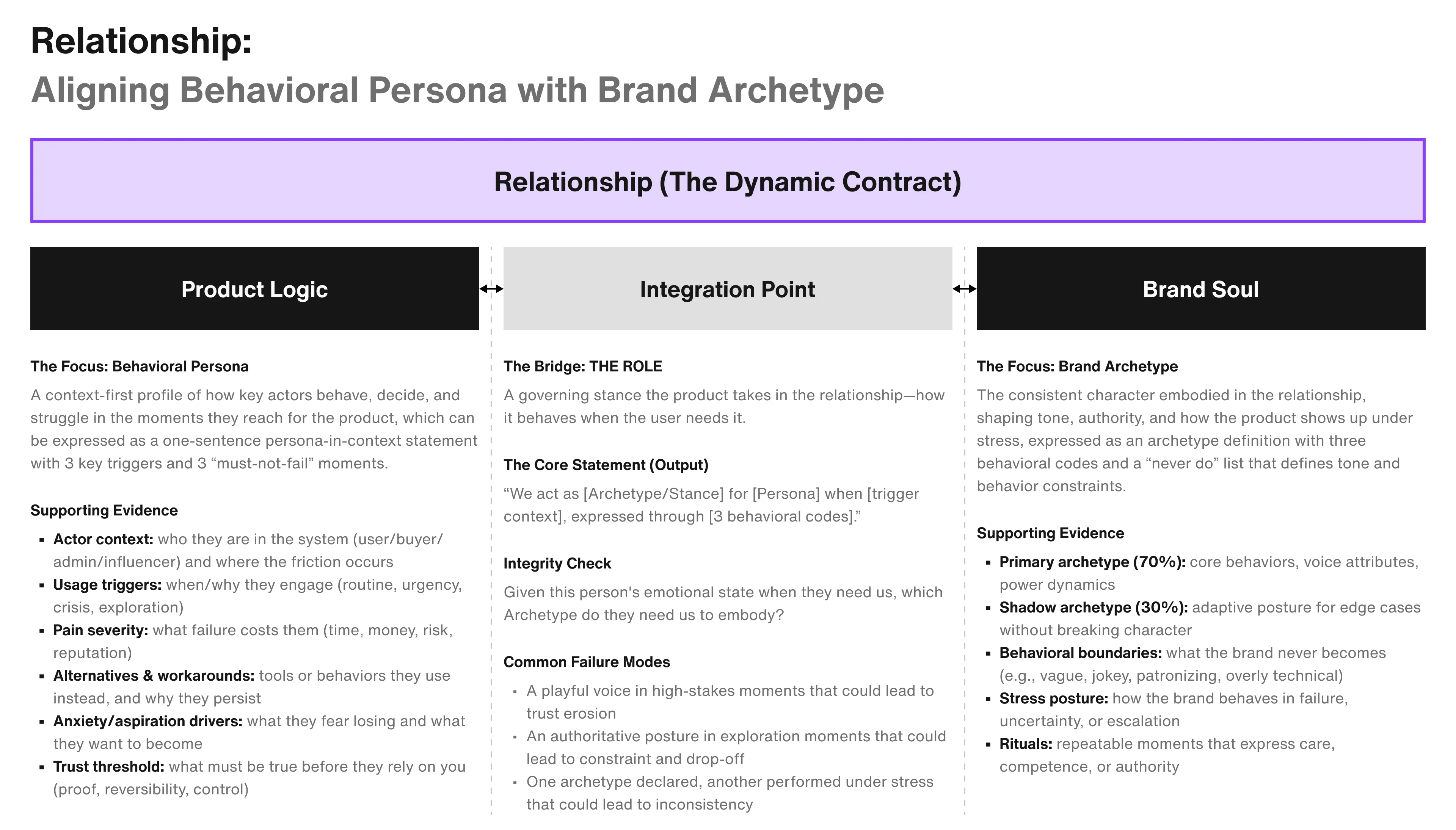
Relationship translates a behavioral persona into a brand archetype to define the product’s governing role, tone, and authority in moments of need.
(Relationship: The Dynamic Contract)
Most products do not have a single user. In enterprise software, the buyer is often not the operator. In platforms and marketplaces, multiple sides must be served simultaneously. In infrastructure products, developers use the system while security teams, procurement officers, and compliance functions constrain what can be adopted. A persona alone cannot capture this complexity. Relationship must be modeled as an actor system that reflects the full set of stakeholders shaping outcomes.

On the Product Logic side, Relationship defines the Behavioral Persona: the roles shaping adoption, usage, governance, and renewal. In most software products, the minimum viable set includes the end user who performs the work, the buyer who approves the budget, the administrator or governor who configures and maintains the system, the influencer who recommends or blocks adoption, and the beneficiary whose outcomes are improved even if they never touch the interface. Each actor has distinct jobs, anxieties, and success criteria, and the product must serve all of them coherently or risk adoption failure at any gate.

On the Brand Soul side, PRIME defines a Brand Archetype: the role the product plays in the relationship when the actor needs it. This stance is deliberately universal, designed to generalize across categories and contexts. Whether you ship a consumer app, a B2B workflow tool, or a developer platform, your product typically behaves as one of a small set of stances. A Guardian protects and prevents harm. A Guide educates and surfaces insight. An Authority provides standards and enforces compliance. An Ally collaborates and adapts to context. An Enabler removes constraints and increases autonomy. A Challenger provokes and reframes assumptions. The stance is not arbitrary — it must match the actor's emotional and operational state when they engage the product.

The integration contract is the Role, tested by asking whether the stance is what the actor needs in their context. This is where brand becomes operational for product teams, because stance is expressed through behavior rather than messaging. Defaults, hierarchy, onboarding posture, error-handling tone, permission models, and the way the system behaves under stress all communicate stance. A product that positions itself as an Ally but behaves like an Authority during errors will drain trust faster than one that never articulated a stance at all. A mismatch here does not create mild inconsistency — it creates experiential dissonance that users may not be able to name but will reliably avoid.

The practical implication is that different actors may require different stances within the same product. A security platform might be a Guardian to compliance teams, an Enabler to developers, and a Guide to executives reviewing dashboards. PRIME does not require a single stance across all actors, but it does require that each stance be consistent within its domain and that transitions between stances be intentional rather than accidental.
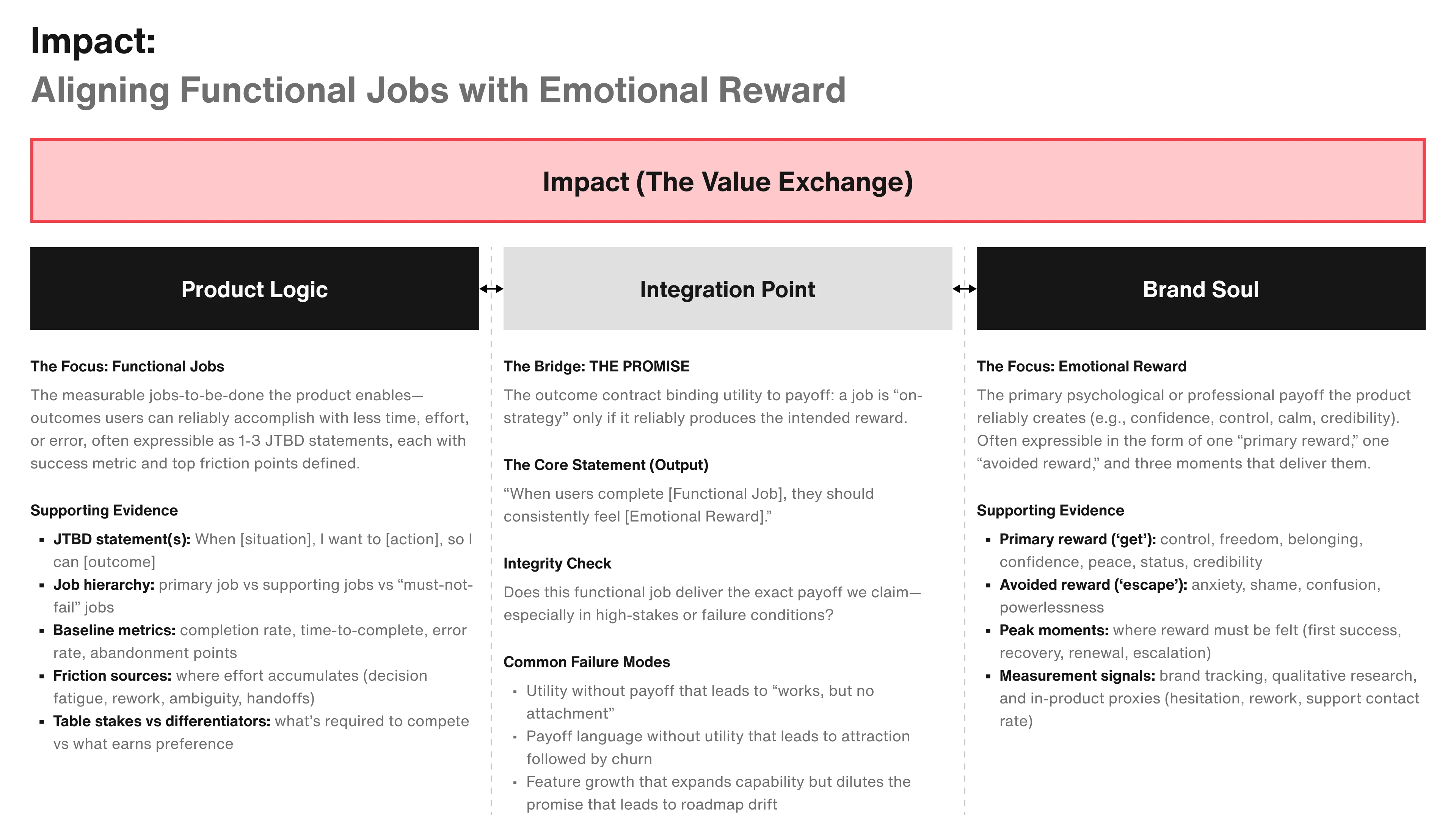
Impact binds functional jobs-to-be-done to an emotional reward so the promise is not only delivered, but reliably felt.
(Impact: The Value Exchange)
Teams often split value into two silos that rarely communicate. Product defines value as utility measured in task completion, time saved, or errors prevented. Brand defines value as resonance measured in sentiment, recall, or affinity. PRIME treats value as a single exchange with two inseparable components: what the product enables functionally, and what that enablement produces as payoff in the user's mind, identity, and decision-making context.

On the Product Logic side, Impact is articulated through Jobs-to-be-Done expressed in situational context: when a specific situation occurs, the actor wants to accomplish something so they can achieve a concrete outcome. The formulation forces precision. "Manage tasks" is too vague. "When a project deadline moves up unexpectedly, I want to re-prioritize work across my team so I can communicate new commitments without missing dependencies" is testable. This specificity allows teams to design for actual hiring criteria rather than assumed needs, and it clarifies which features matter for differentiation versus those required merely for completeness.

On the Brand Soul side, Impact is articulated through Emotional Reward: the emotional, cognitive, or social outcome the user experiences when the job is done well. This is intentionally broader than emotion, so it generalizes across categories and avoids the reductive language that makes a brand feel decorative in technical contexts. In consumer contexts, payoff may include confidence, belonging, autonomy, status, or relief. In B2B contexts, payoff is often professional and reputational: reduced anxiety about risk, increased credibility with stakeholders, defensible decisions that protect career capital, and a stronger sense of control in uncertain environments. Payoff is what makes a completed job memorable and repeatable rather than merely satisfactory.

The integration contract is the Promise: the commitment that functional outcomes reliably produce the intended payoff. This is where prioritization becomes principled rather than reactive. Parity features may be required as the price of entry, but they rarely compound differentiation because they deliver utility without intensifying payoff in a way the market can recognize and remember. Differentiation compounds when investments strengthen utility while simultaneously deepening payoff, creating a reinforcing loop where better outcomes produce stronger meaning, which in turn increases willingness to adopt, expand, and advocate.

Parity earns the right to compete, but it does not secure preference. Preference emerges when the product becomes the best answer not just to "what can do this job?" but to "what makes me feel the way I want to feel when this job is done?"

The Promise contract ensures that roadmaps are evaluated not just for what they add, but for whether they intensify the meaning users associate with choosing the product in the first place.
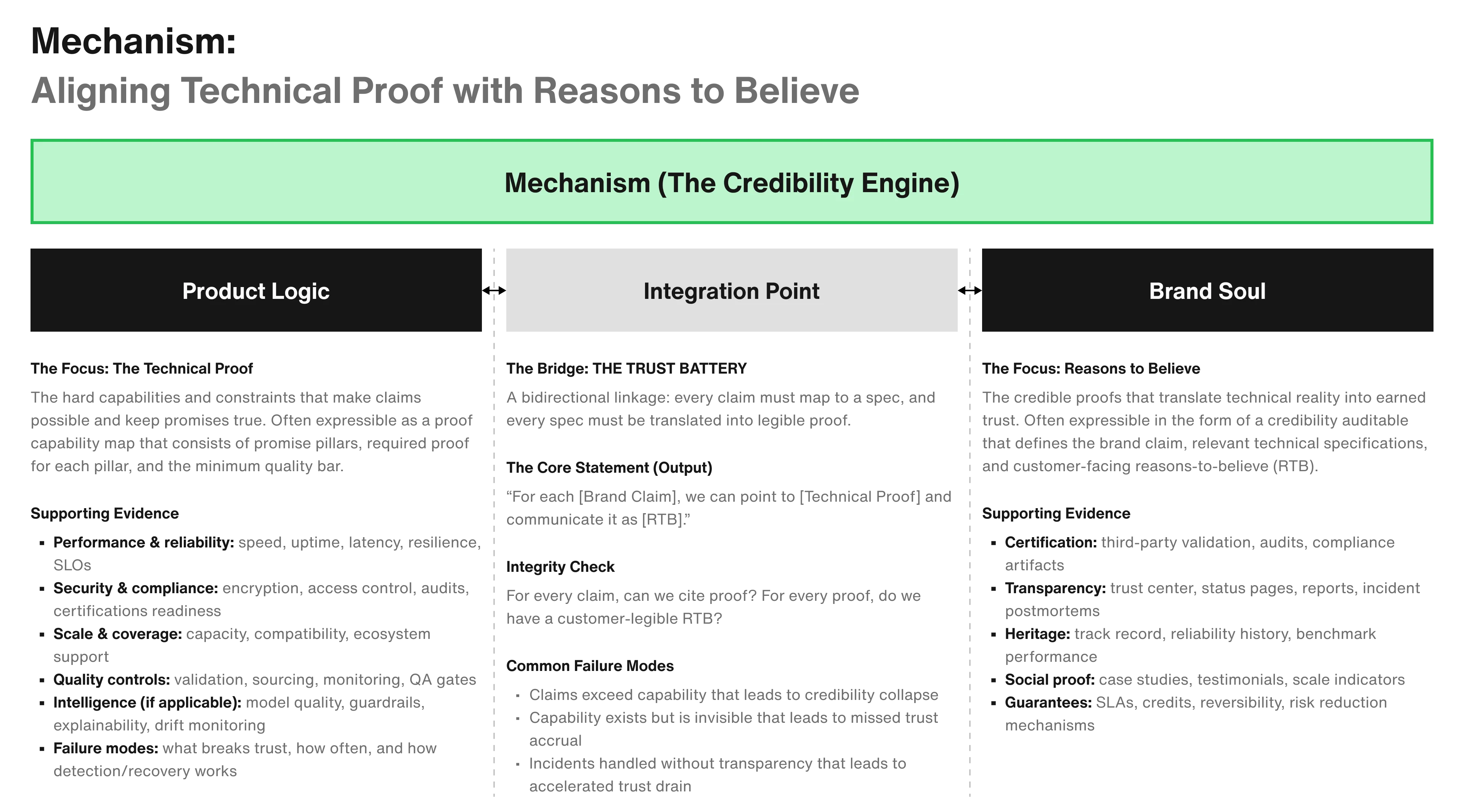
Mechanism connects technical proof to customer-legible reasons to believe, converting capability into earned trust at scale.
(Mechanism: The Credibility Engine)
Most brand narratives fail not because they are poorly written, but because they are under-proven. Trust is not generated by intent or aspiration. Trust is generated by evidence, and evidence only compounds when it is made legible to the audiences who need it. Without this translation layer, even genuine capability remains inert, unable to shape perception or influence decisions.

On the Product Logic side, Mechanism is the Technical Proof: the hard constraints and measurable systems that make claims verifiable rather than rhetorical. Depending on the product category, this includes reliability and performance guarantees that establish predictability, security and privacy controls that protect sensitive data, compliance frameworks and safety measures that satisfy regulatory or ethical standards, governance structures and auditability that enable oversight, and, in AI-enabled products, model quality benchmarks, behavioral guardrails, and explainability mechanisms that reduce opacity. These are not marketing talking points — they are the infrastructural investments that determine whether a claim can be tested and whether it will hold under stress.

On the Brand Soul side, Mechanism is expressed through Reasons to Believe: the artifacts and practices that translate capability into credibility for external audiences. These include third-party certifications that provide independent validation, transparency reports that demonstrate accountability, contractual guarantees that create recourse, customer references that offer social proof, public status pages that communicate operational honesty, and incident communications that turn failures into trust-building moments through candor and speed. Reasons to Believe are not passive collateral — they are active instruments for converting capability into market perception.

The integration contract is the Trust Battery, a metaphor that captures the dynamic and cumulative nature of credibility. The battery charges when claims are supported by demonstrable capability and translated into legible proof that audiences can access and verify. It drains when organizations make claims without underlying capability, ship capability without making it visible or understandable, or experience incidents without transparency or accountability. The battery is not binary — it degrades gradually through small inconsistencies and can be depleted entirely through single catastrophic failures, but it can also be rebuilt systematically through repeated evidence of alignment between promise and reality.

Operationalizing this contract requires discipline. Teams must map each external claim to the capability that supports it and the reason-to-believe that makes it legible. A claim like "enterprise-grade security" must be backed by capabilities such as encryption standards, access controls, and audit logs, and made credible through artifacts like SOC 2 certification, penetration test results, or a public bug bounty program. When this mapping is incomplete, the claim becomes a liability rather than an asset, raising expectations the product cannot meet and inviting skepticism that spreads faster than correction.

This is also where many organizations underinvest. They build robust capabilities but fail to translate them into market-facing proof, leaving differentiation trapped inside the product where only power users can discover it. PRIME prevents this by treating credibility as a design problem requiring both capability and communication, engineering and evidence, substance and signal.
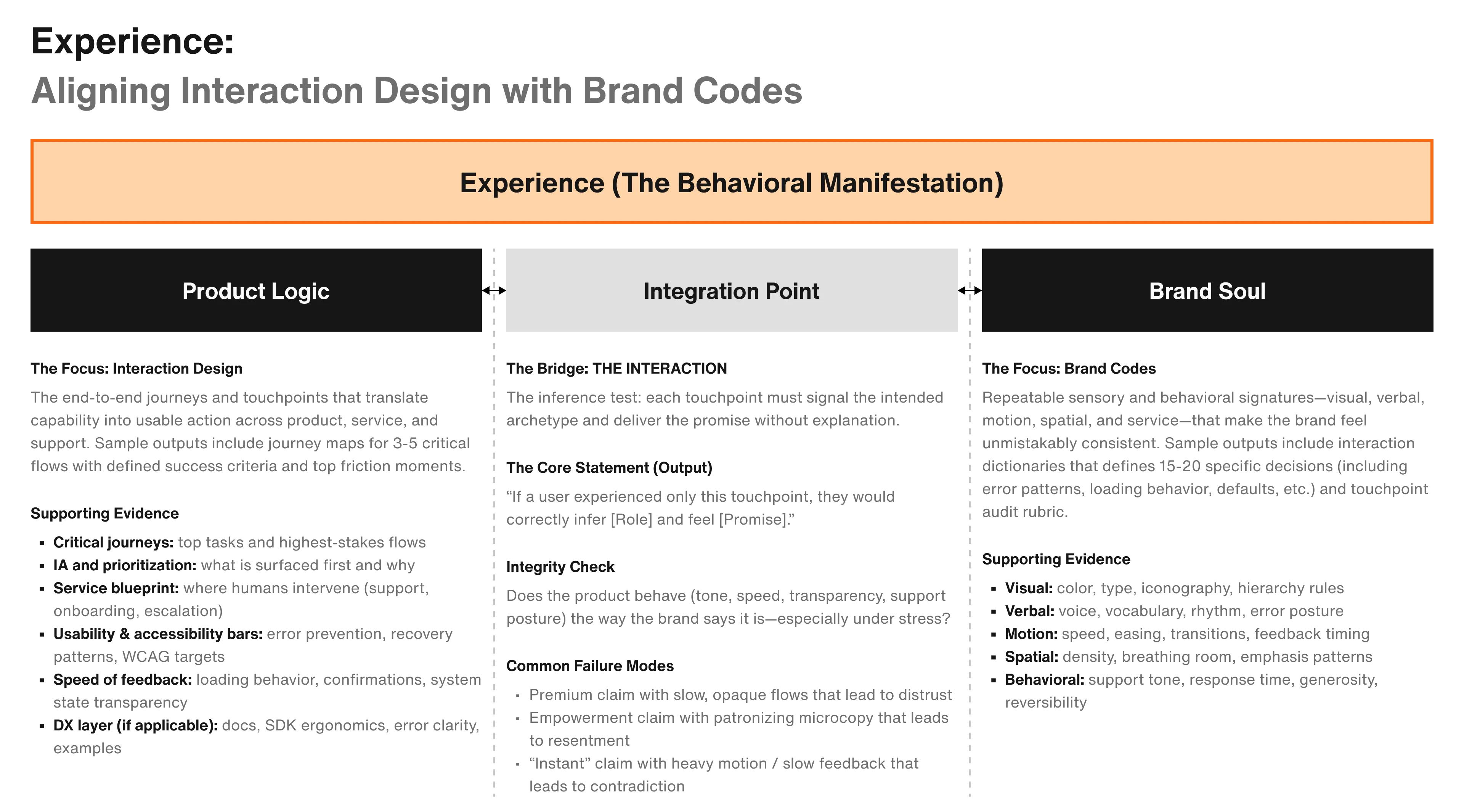
Experience aligns interaction design with brand codes so each touchpoint signals the intended archetype and delivers the promise without explanation.
(Experience: The Behavioral Manifestation)
In software, brand is not primarily a visual identity system composed of logos, color palettes, and typography guidelines. It is behavior across touchpoints — the accumulated impressions users form through repeated interactions with the product in contexts that matter to them. Experience is where the system's meaning is either confirmed or contradicted in the moments users remember, and where abstract promises become concrete realities that shape future decisions.

On the Product Logic side, Experience is the Interaction Design: the full set of touchpoints users and stakeholders encounter across the lifecycle. This includes UI flows that govern core workflows, onboarding sequences that establish initial understanding, documentation that supports learning and troubleshooting, billing and subscription interfaces that manage the commercial relationship, permissions and access controls that define boundaries, customer support channels that handle exceptions, and incident communications that manage trust during failures. For developer products, this extends to API ergonomics, SDK quality, error message clarity, and the effectiveness of debugging tools. Each touchpoint is an opportunity to reinforce or undermine the product's meaning.

On the Brand Soul side, Experience is expressed through Brand Codes: the design and behavioral rules that govern how the product feels and sounds across all contexts. These codes translate abstract stance and promise into tangible decisions about visual language, interface voice and tone, motion and animation principles, spatial rhythm and information density, and service posture in support interactions. Brand Codes are not aesthetic preferences — they are governance mechanisms that ensure consistency without requiring centralized approval of every decision. When properly defined, they allow distributed teams to make locally coherent choices that remain globally aligned.

The integration contract is the Interaction, tested through a single inference question: if someone experienced only this touchpoint with no prior context, would they correctly infer the product's role and promise? This test is deliberately strict because most users do not experience products linearly or comprehensively. They sample touchpoints opportunistically based on immediate need, and they form judgments from fragments. A user who encounters only the error state, the billing page, or the support chat must still come away with an impression consistent with the product's intended meaning, or the system leaks equity through misalignment.

Small choices — error tone that shifts from helpful to defensive, loading states that obscure rather than inform, reversibility that protects users versus systems that punish mistakes — often do more to build or drain trust than any campaign or keynote.

PRIME prevents drift by codifying these decisions into an Interaction Codex: a living document that captures precedent and provides guidance for new contexts, established through a regular audit cadence to identify and correct inconsistencies before they compound into contradictions. The practical outcome is that Experience becomes the enforcement layer for higher-level commitments. If Purpose defines what the organization stands for and Promise defines what outcomes it enables, Experience determines whether users believe it. Without this manifestation layer, the brand remains theoretical — a set of aspirations documented in decks but not delivered in reality. With it, brand becomes lived, testable, and improvable through the same iterative processes teams already use to refine features and resolve bugs.
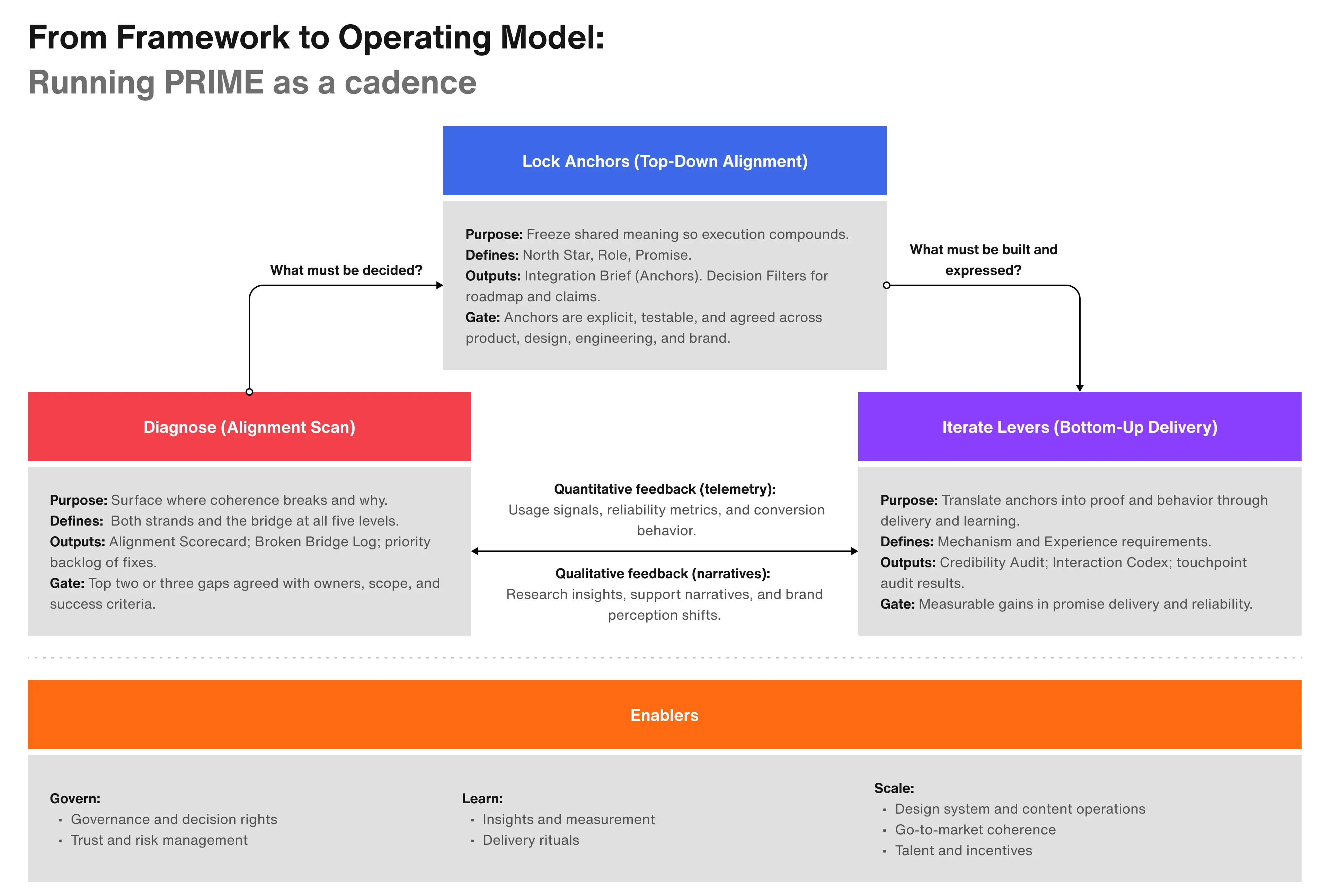
Running PRIME operationalizes the model as a repeatable cadence—lock anchors, diagnose misalignment, and iterate delivery levers—supported by governance, learning loops, and scale enablers.
(From Framework to Operating Model)
PRIME is most valuable when it is used as a cadence rather than a poster on the wall. In practice, teams begin by diagnosing which bridges are broken and which levels are under-specified. This diagnostic phase typically reveals that organizations have invested unevenly: strong capability without a clear stance, compelling narrative without a proven architecture, polished interfaces that contradict the promised role. The goal is not perfection but coherence — ensuring that each level is sufficiently defined to support the levels below it and that contracts between strands are explicit enough to be tested.

Teams then lock the anchors top-down — Purpose, Relationship, Impact — because downstream execution cannot compensate for upstream ambiguity. If the North Star is unclear, no amount of design refinement will produce strategic coherence. If the Behavioral Persona is incomplete, the product will optimize for some stakeholders while alienating others. If the Promise is vague, prioritization becomes political rather than principled. These anchors change infrequently and should be revisited only when market conditions, competitive dynamics, or organizational strategy shift fundamentally.

From there, teams iterate bottom-up — Mechanism and Experience — because proof and behavior are the levers that convert intent into lived reality and the domains where rapid learning is both possible and necessary. Capability investments can be sequenced based on feasibility and impact. Touchpoints can be audited, redesigned, and tested against the inference standard. Reasons to Believe can be developed as capabilities mature. This iterative layer allows teams to improve alignment continuously without requiring wholesale redesign.

The decision rule is intentionally simple: higher levels normally govern lower levels. Experience should not contradict Purpose; proof should not contradict Promise. When conflicts arise, teams default to resolving them by adjusting lower levels to align with higher anchors. But PRIME is not naive about constraints. It includes a hard-constraints override: when legal, security, safety, or economic viability constraints are existential, they override aspirational commitments and force the organization to rewrite higher-level claims to match what can be delivered credibly. This prevents the model from becoming aspirational theater disconnected from operational reality. Integrity requires that promises reflect constraints, not ignore them.

The practical outcome is a shared language for product, design, engineering, and brand leaders to resolve trade-offs without collapsing into subjective taste or organizational politics. PRIME turns brand-led product from a narrative ambition into an integration discipline: a repeatable, testable way to design what the product means, prove it systematically, and make it feel true — touchpoint by touchpoint, decision by decision — over time. It does not eliminate the need for judgment, but it clarifies what judgment should optimize for and provides a structure for evaluating whether execution is compounding equity or merely generating output.