(ML)
DESIGN DIRECTOR
Tokyo, Japan (JST)
00
:
00
:
00
AM
Menu
Close
Honda ConnectX - Developing the next generation of connected applications
strategy
PRODUCT
experience
(Project summary)
On January 10, 2024, at CES in Las Vegas, Honda unveiled the Honda 0 Series, marking the brand’s bold entry into a new era of electric mobility. Guided by the design and development principles of Thin, Light, and Wise, the Honda 0 Series represents more than the launch of a new EV lineup—it signals Honda’s ambition to integrate electric vehicles seamlessly into the everyday lives of its users and redefine the future of mobility itself.

But Honda 0 is more than a collection of vehicles. It is a holistic ecosystem—a vision that extends beyond cars to encompass digital experiences, infrastructure, and connected services. As part of this transformation, Honda initiated a complete redevelopment of its connected application ecosystem, preparing it to support the brand’s next-generation EV strategy.

Working in close partnership with Honda and key collaborators, our creative team was entrusted with shaping a next-generation connected app concept, code-named Honda ConnectX. Positioned as the foundation for Honda’s next chapter, ConnectX is designed to be the digital backbone of the Honda 0 experience—bringing the principles of Thin, Light, and Wise to life in a way that connects people, vehicles, and technology like never before.
(The project in numbers)
4.65m
Projected new EVs joining the connected ecosystem
3x
Expected revenue growth within five years
+20%
Anticipated five-year expansion of the connected ecosystem
+30%
Forecasted five-year lift in ARPU
Honda 0’s concept (announced at CES 2024) and its guiding pillars: Thin, Light, Wise
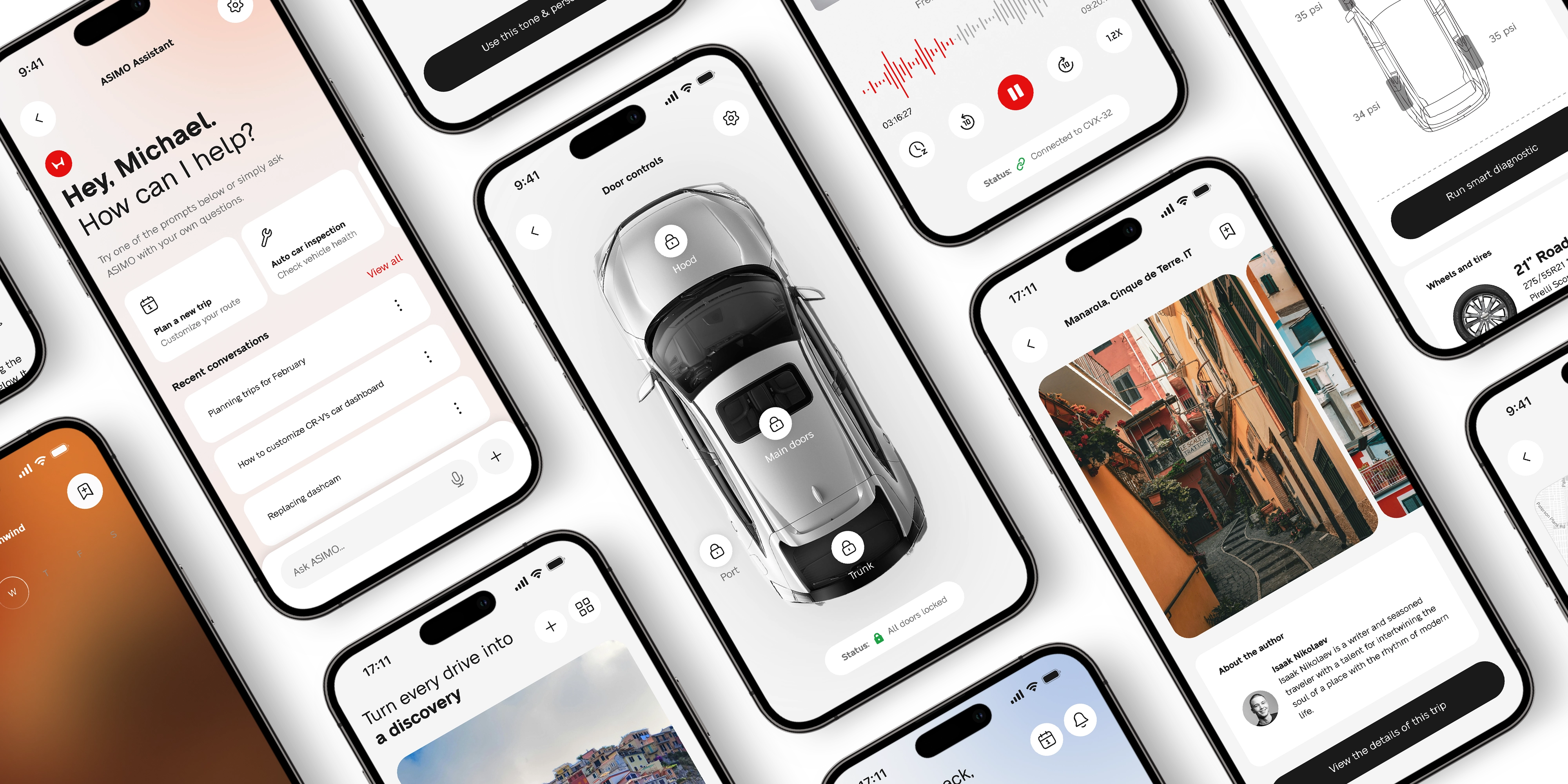
The final Honda ConnectX at a glance
Understanding the current Honda CONNECT ecosystem
(Honda CONNECT's standing in the global market)
Before shaping the new ConnectX concept, we first needed a deep understanding of Honda’s existing CONNECT ecosystem. Together with our collaborators, we conducted two independent studies: one in Japan and one in Western markets (U.S./EU), both using public pricing, application footprints, owner feedback, and competitive teardown.

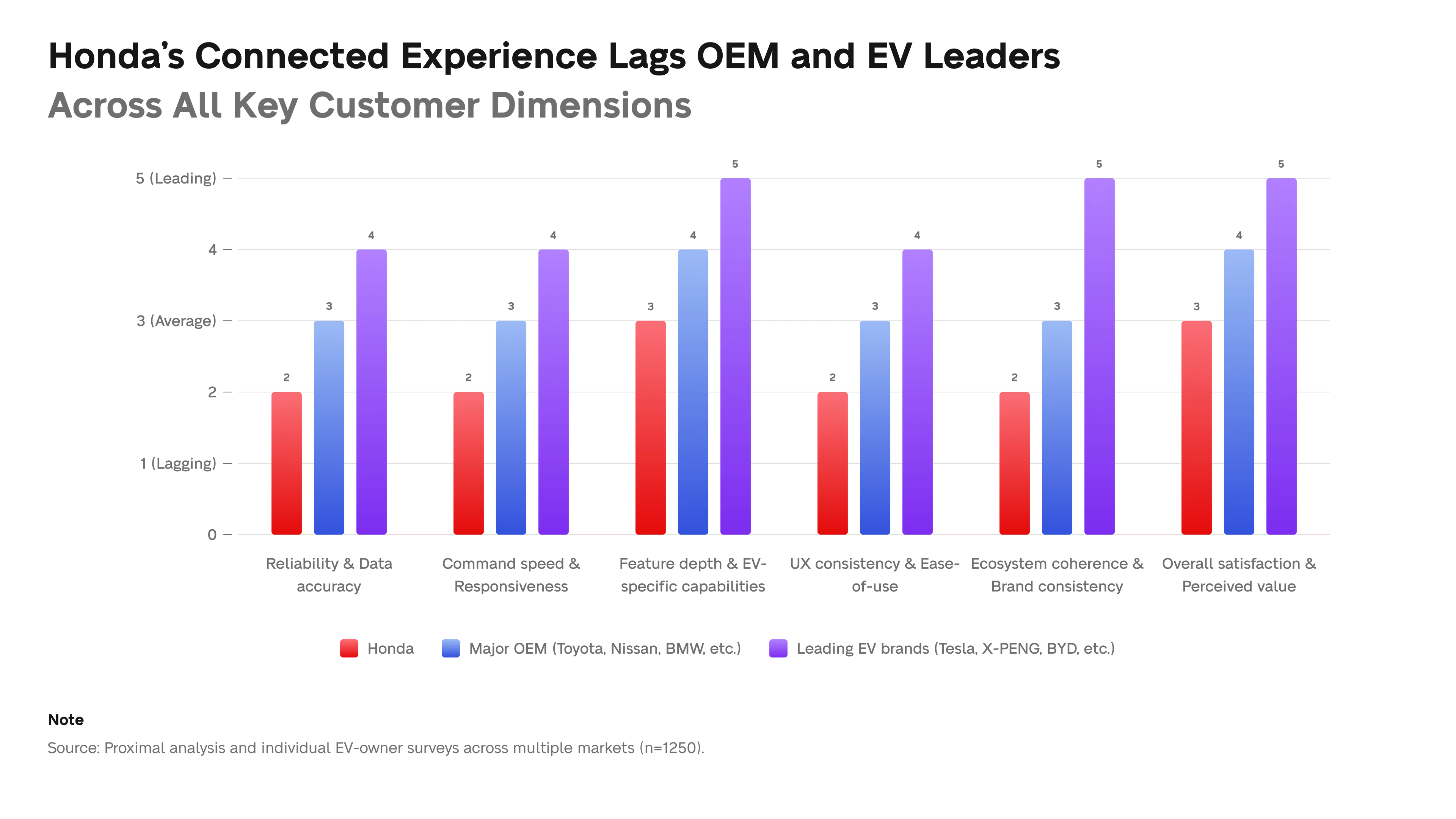
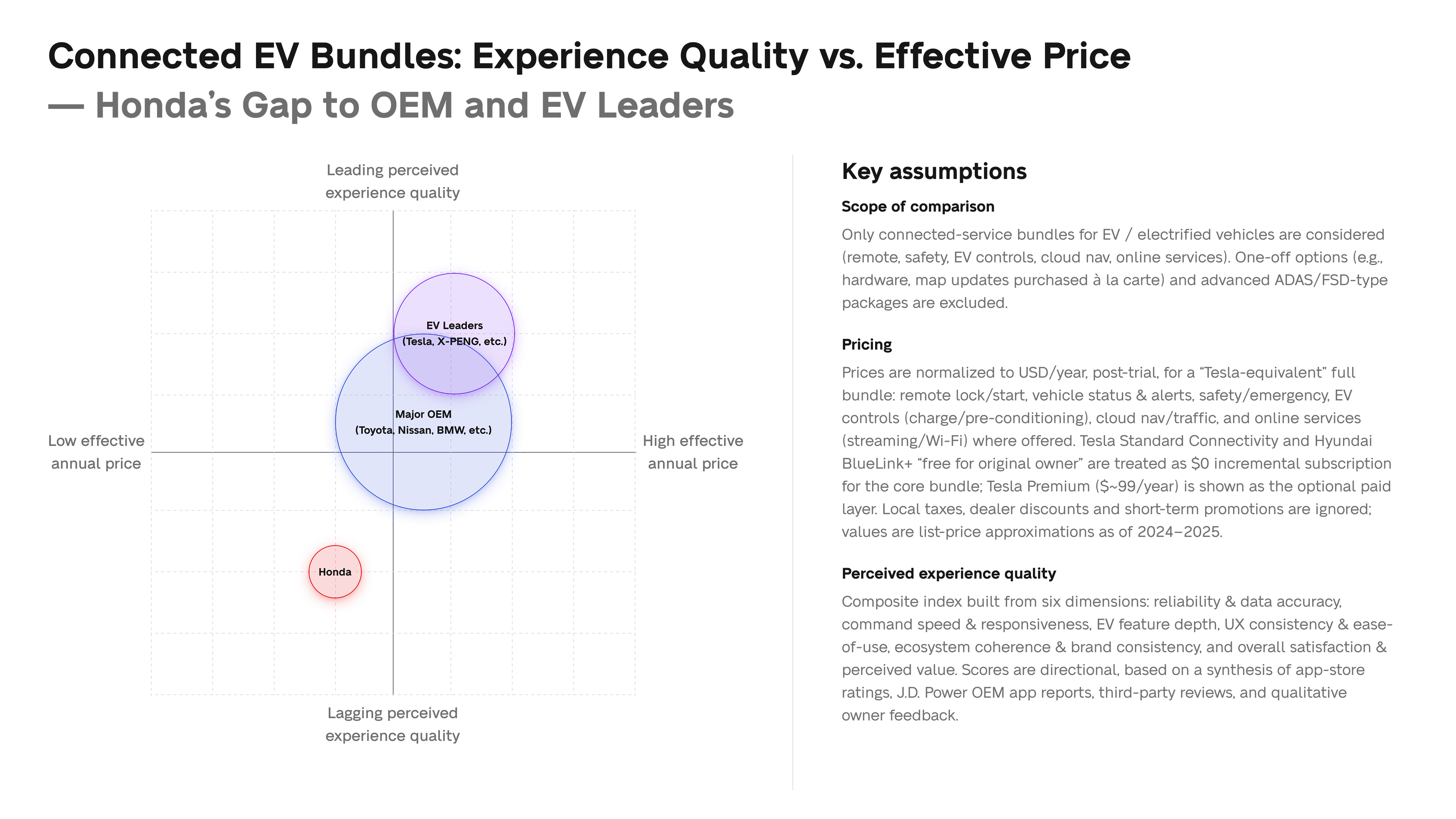
The findings were clear: Honda trails leading peers on perceived value, adoption, and price realization in both markets. In particular, many users—especially in Western markets—perceive the current ecosystem as fragmented and providing insufficient value, resulting in a depressed price point for Honda, which is now below both incumbent OEMs (including both Japanese competitors such as Toyota and Nissan, and foreign competitors such as BMW, Volvo, etc.) and leading EV brands (such as Tesla, Rivian, BYD, X-PENG, etc.). This value gap has become a key constraint on Honda’s growth.
Our sentiment analysis revealed that Honda's connected service underperformed in major aspects compared to both major OEMs and EV leaders
Sentiment analysis and price sensitivity analysis further highlighted Honda's current missed opportunity for its connected ecosystem
(From POP to POD: turning ambition into advantage)
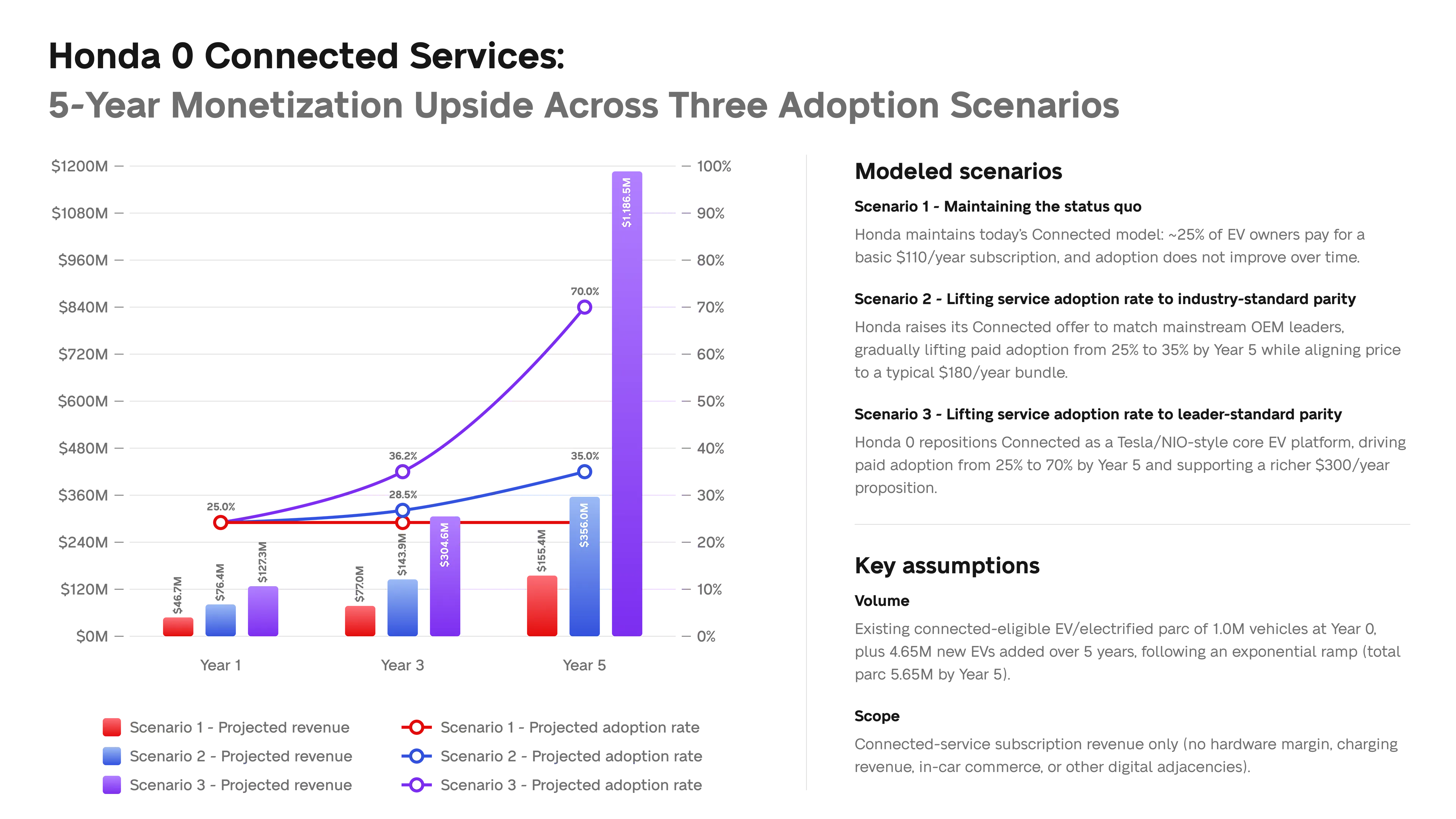
With connected applications and services playing a critical role in car-purchase decisions, these gaps represent both a challenge and a major opportunity, especially when OEMs are increasingly seeing software as a primary growth engine for automotives. Our scenario modeling showed that simply bringing Honda to feature and price parity (POP) with major OEM leaders and competitors could double current revenue.

But we aimed higher. In the era of EVs and connected experiences, differentiation no longer comes only from the vehicle itself—it can also come from the connected ecosystem. Brands like Tesla and BYD have already proven this strategy viable. Indeed, when modeled using the average adoption rate and price point from leading brands, our simulation revealed a 9x revenue improvement over the current status quo.

Resultantly, rather than stopping at parity, our team set a bolder goal: to transform Honda’s connected ecosystem from a basic set of services into a Point of Differentiation (POD).
Our scenario modeling for Honda ConnectX, highlighting the financial potential for the service
The new Honda ConnectX's direction
(Rethinking the role of Honda CONNECT)
To create a true point of differentiation, we began by rethinking the role of mobility itself. Traditionally, mobility is seen simply as transportation from Point A to Point B. We believe it is far more: a mode of connection—linking people to opportunities, dreams, and memories that enrich their lives.

Honda’s next-generation connected ecosystem should reflect this vision, serving as a digital companion that connects users to life-enhancing experiences rather than merely enabling travel.

This direction aligns seamlessly with the broader Honda 0 vision and its three guiding pillars: Thin, Light, and Wise, ensuring the app becomes a core part of Honda’s next chapter in electric mobility.
ConnectX vision and mission—redefining connected mobility
The first step: Reworking the ecosystem structure
(From multi-app to a one-stop application)
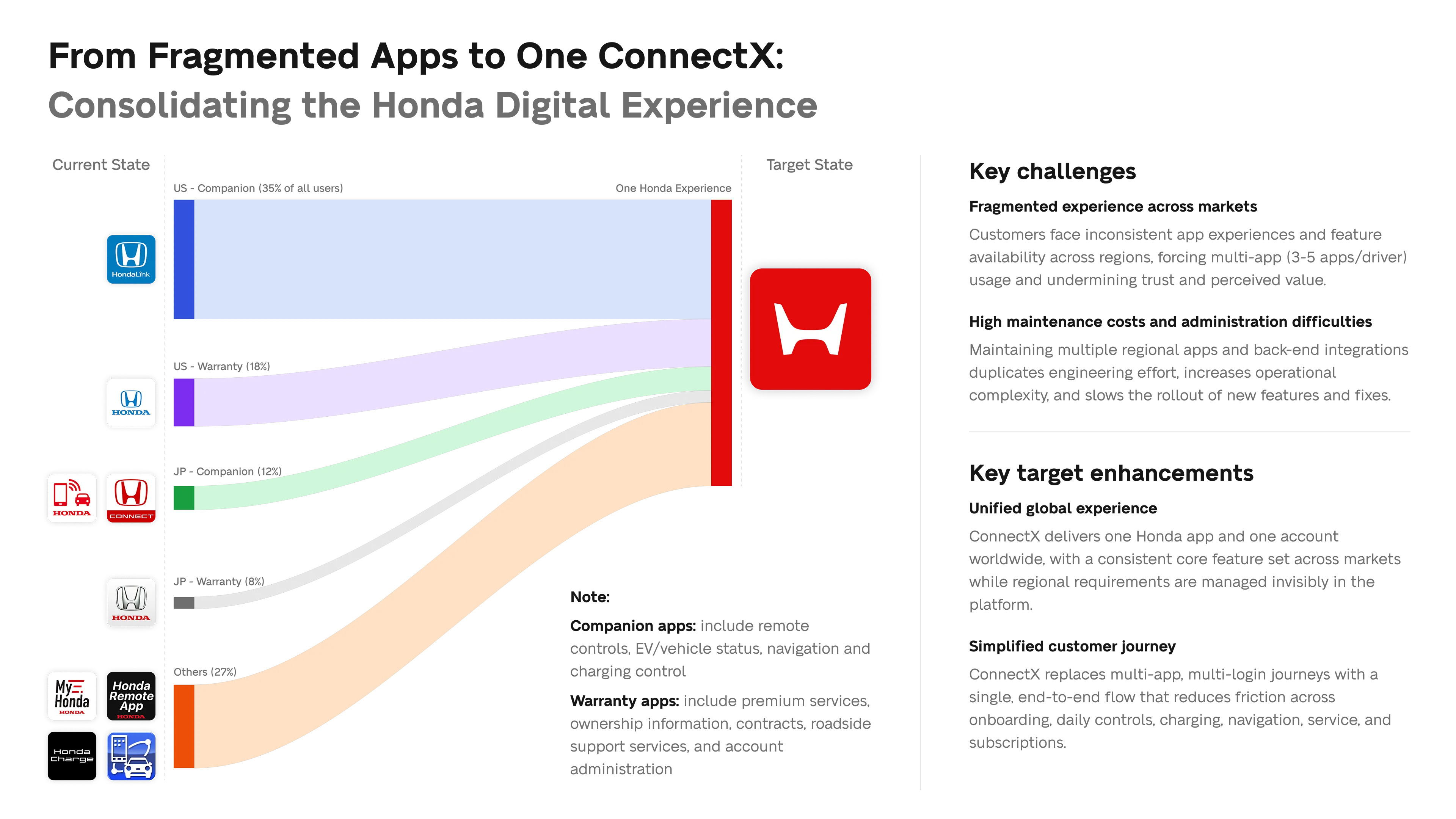
With the direction for Honda ConnectX defined, our first priority was to address the biggest source of user friction within the current Honda CONNECT ecosystem: app fragmentation across markets.

Independent surveys and data analysis revealed widespread frustration among existing Honda users, who often had to juggle multiple applications to access functions that competitors offered in a single platform. Historically, Honda’s multi-app approach was intended to reduce development costs and enable flexible pricing. In practice, however, it produced the opposite effect. Our analysis of operating data and cost lines indicated that maintaining separate apps across the three major markets not only drove higher development and management costs, but also created confusion for users—from managing multiple logins and payment plans to navigating inconsistent experiences. Attempts to offset this friction through lower pricing only further eroded perceived value.

To resolve these issues, our team proposed a unified “one-stop” structure, consolidating the entire ecosystem into a single next-generation application—code-named ConnectX. This approach aligns with long-established best practices in the automotive industry and positions Honda to deliver a simpler, more cohesive connected experience while reducing operational complexity and cost.
From fragmented apps to one unified, one-stop ConnectX experience
ConnectX consolidation: reducing fragmentation to unlock a unified Honda digital experience.
Reworking the application's design
(Setting the direction for a unified experience)
Merging multiple apps into a single Honda ConnectX platform required a ground-up redesign—not only to consolidate existing functions, but to present them through a structure that feels logical and meaningful in everyday use. Reflecting how people actually interact with their vehicles, we organized the experience into three phases—Pre-Trip, Mid-Trip, and Post-Trip—so each moment is supported by the right information and the right tools at the right time.

This phase-based framework allowed us to sharpen priorities in each stage, concentrate on the functions that deliver the most user value, and create room for differentiated capabilities to evolve over time. It also gave us a clear foundation to embed ASIMO Assistant—an AI component within the broader ASIMO OS—in the moments where it is most helpful, ensuring the intelligence feels integrated, purposeful, and consistently valuable across the entire journey.
Each phase addresses distinct user needs—and introduces unique design challenges for ConnectX
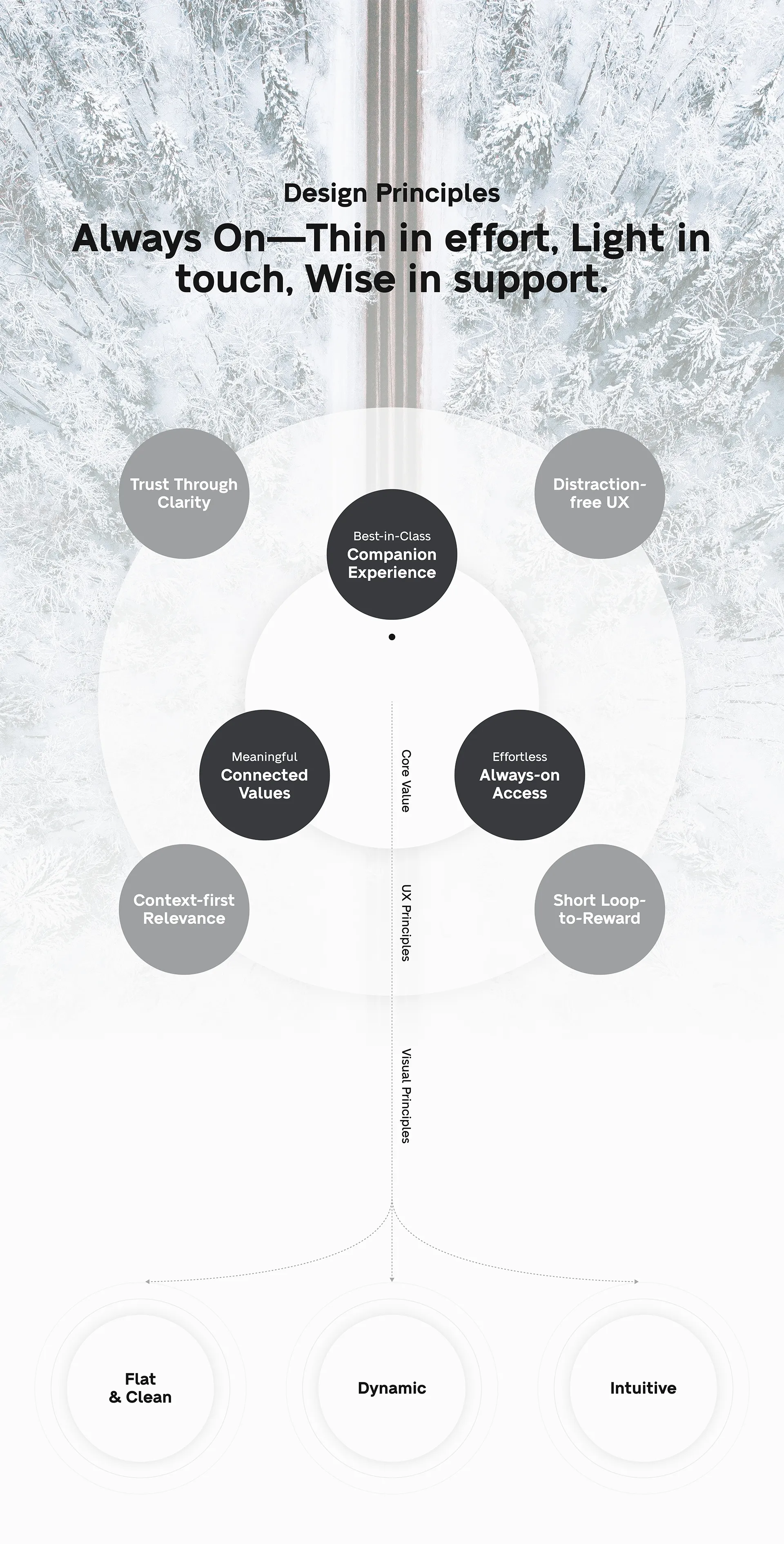
ConnectX core values and the design principles derived from them
(Core functions and design for the Pre-Trip phase)
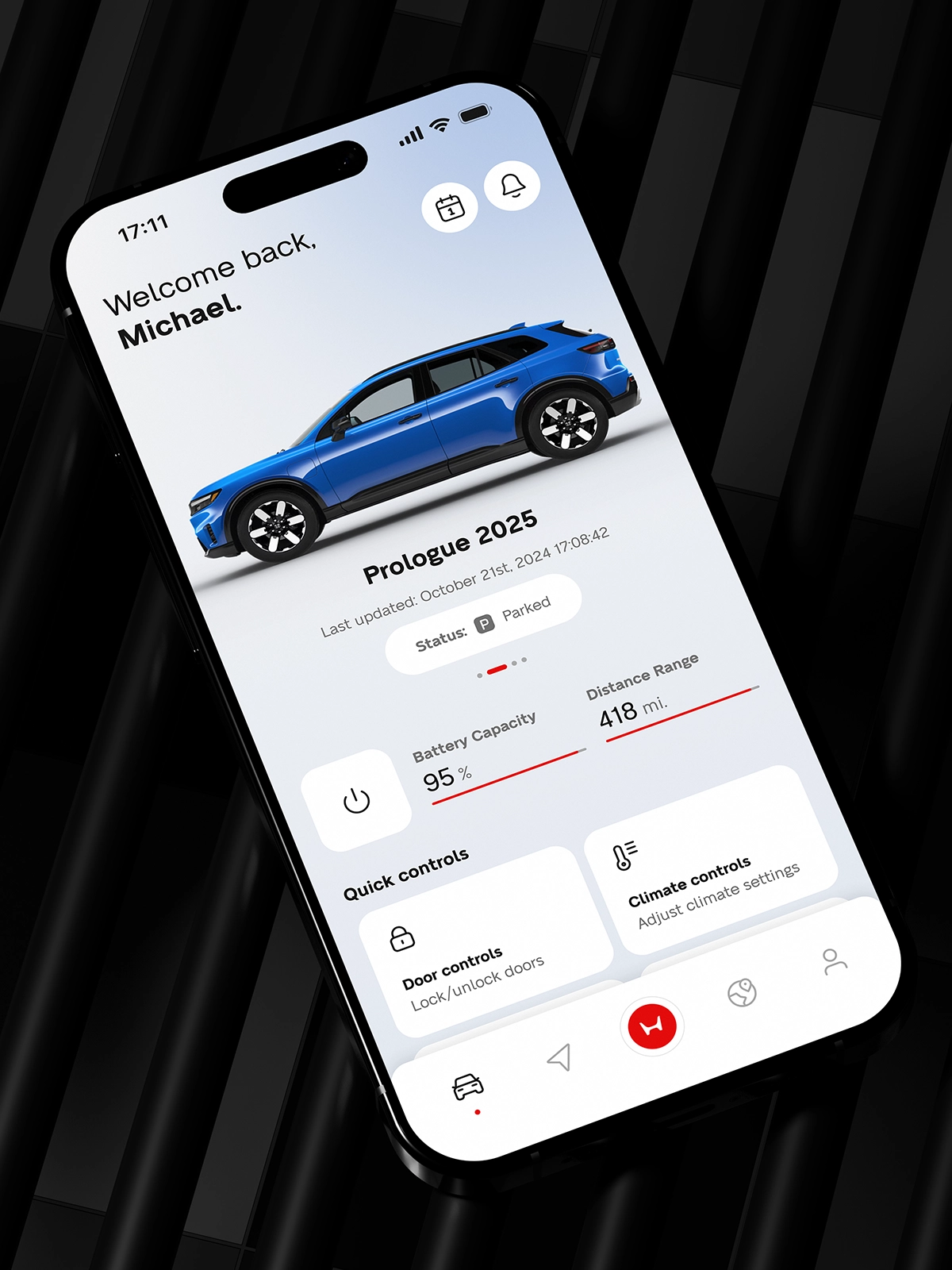
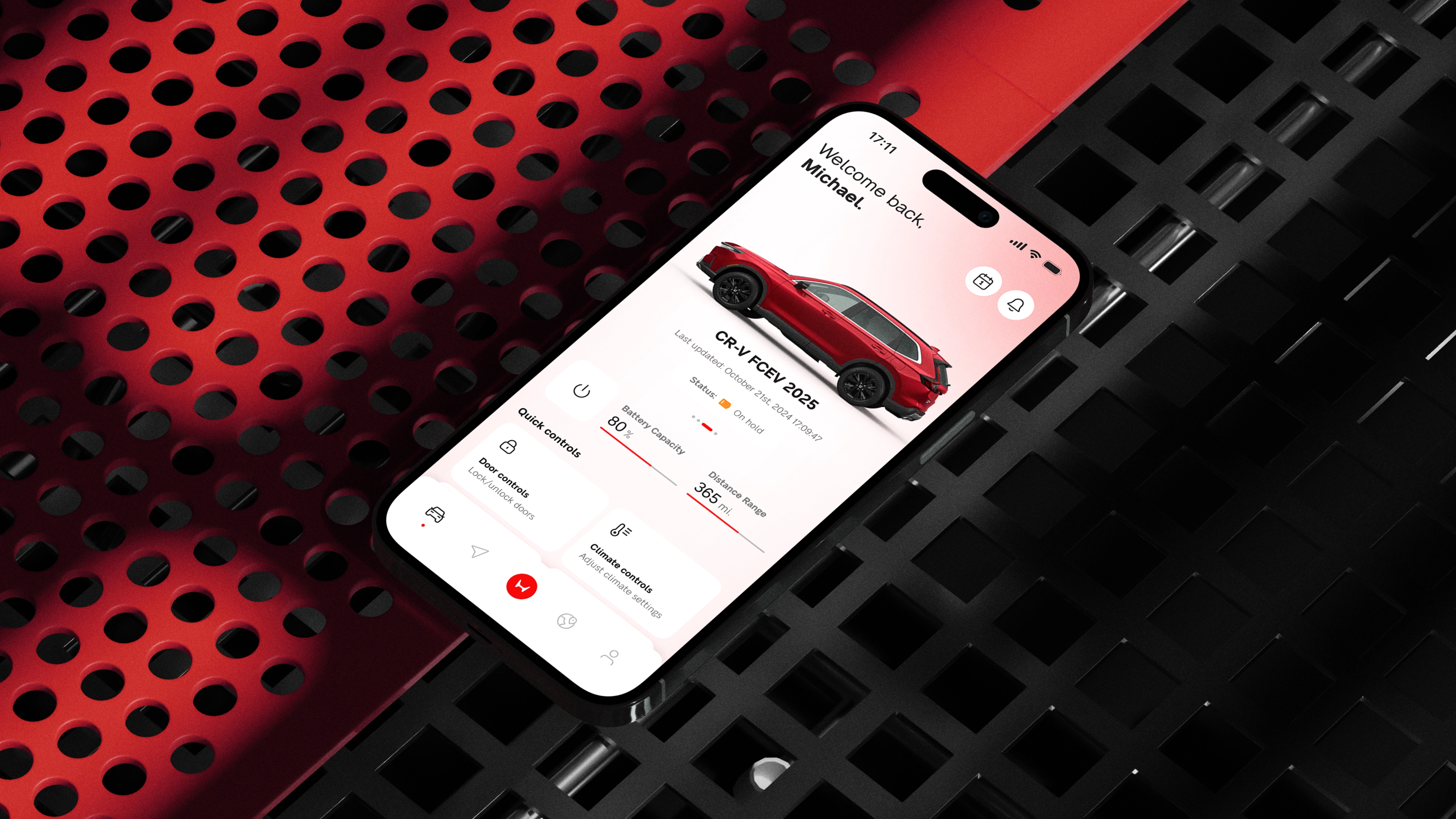
The Pre-Trip phase is the most information-intensive and the most frequently used stage of the ConnectX experience. Here, users check essential vehicle status—such as remaining range and charging progress—prepare the car (pre-conditioning the cabin or optimizing charging cycles), and plan routes. It is also the phase where many competitors concentrate their connected features, which meant our team needed to meet point-of-parity expectations while still shaping a distinct Honda experience.

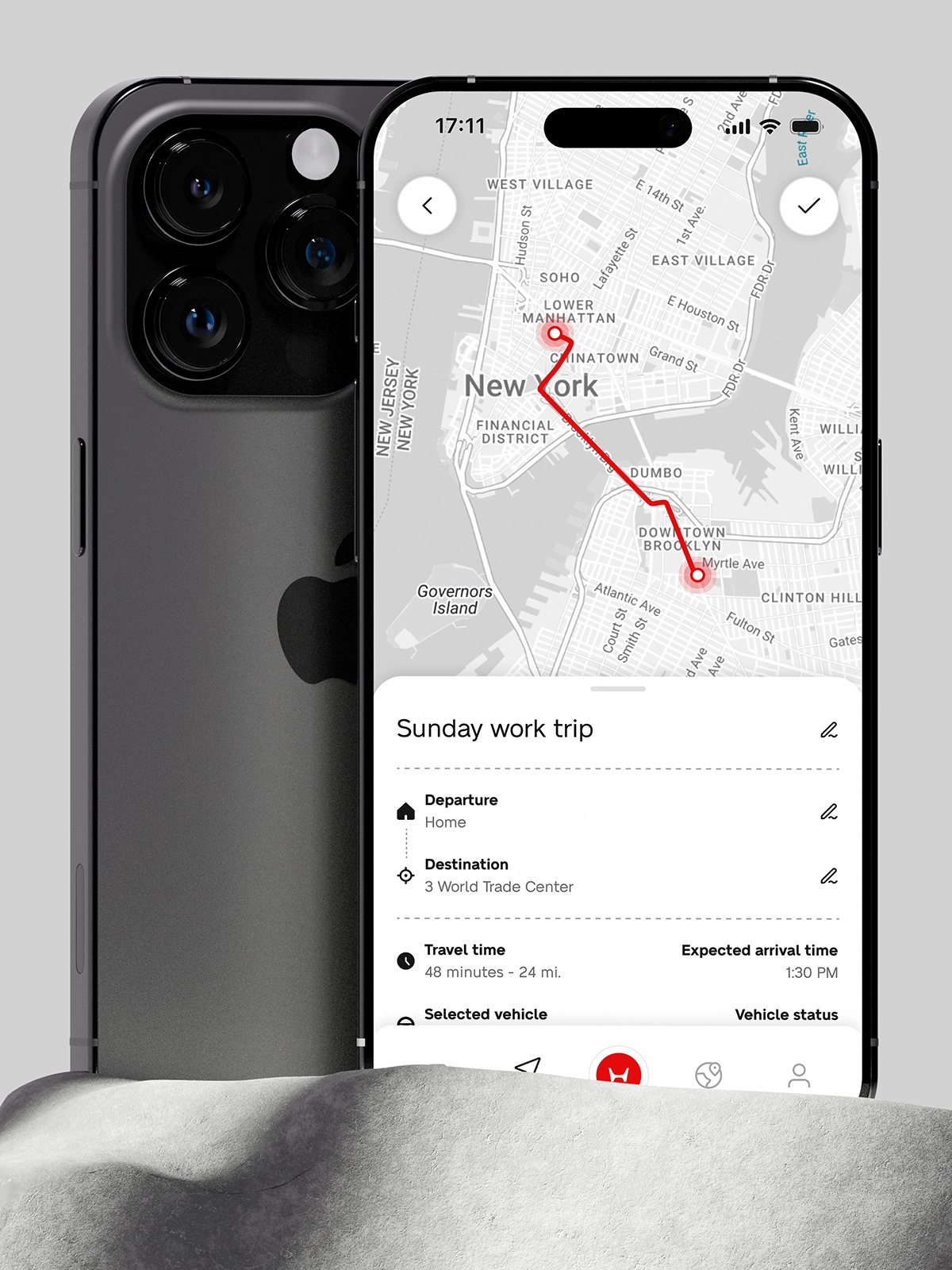
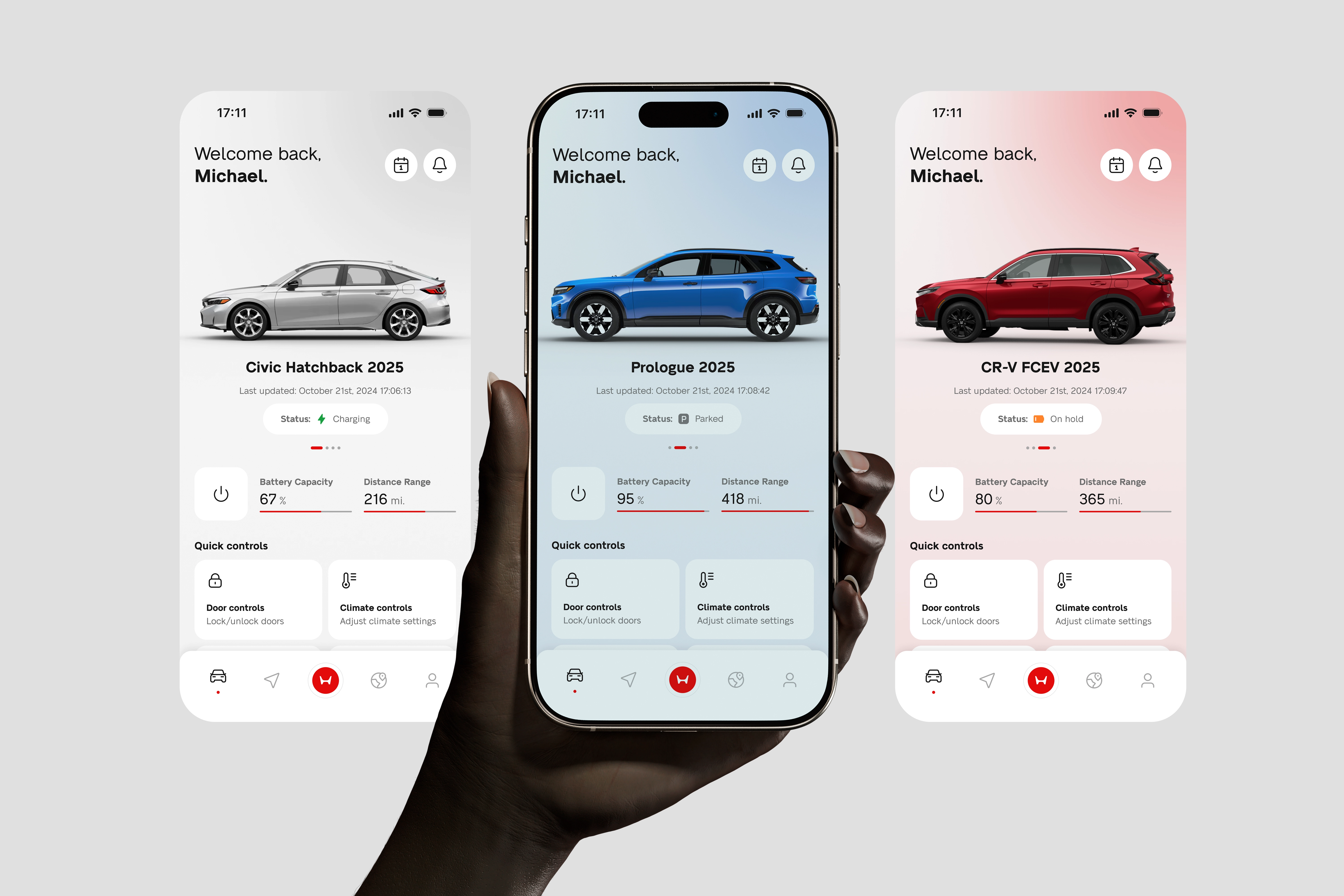
To support these needs, we surfaced critical status information—each vehicle’s real-time condition—directly on the home screen for instant visibility, with priority controls kept within immediate reach. Every screen follows a clean, intuitive layout aligned with our design principles and the Honda 0 pillars of Thin, Light, and Wise, making the experience approachable and confidence-building for all users, regardless of technical expertise.
The new Honda ConnectX's home screen, offering an immediate snapshot and quick control for Honda cars
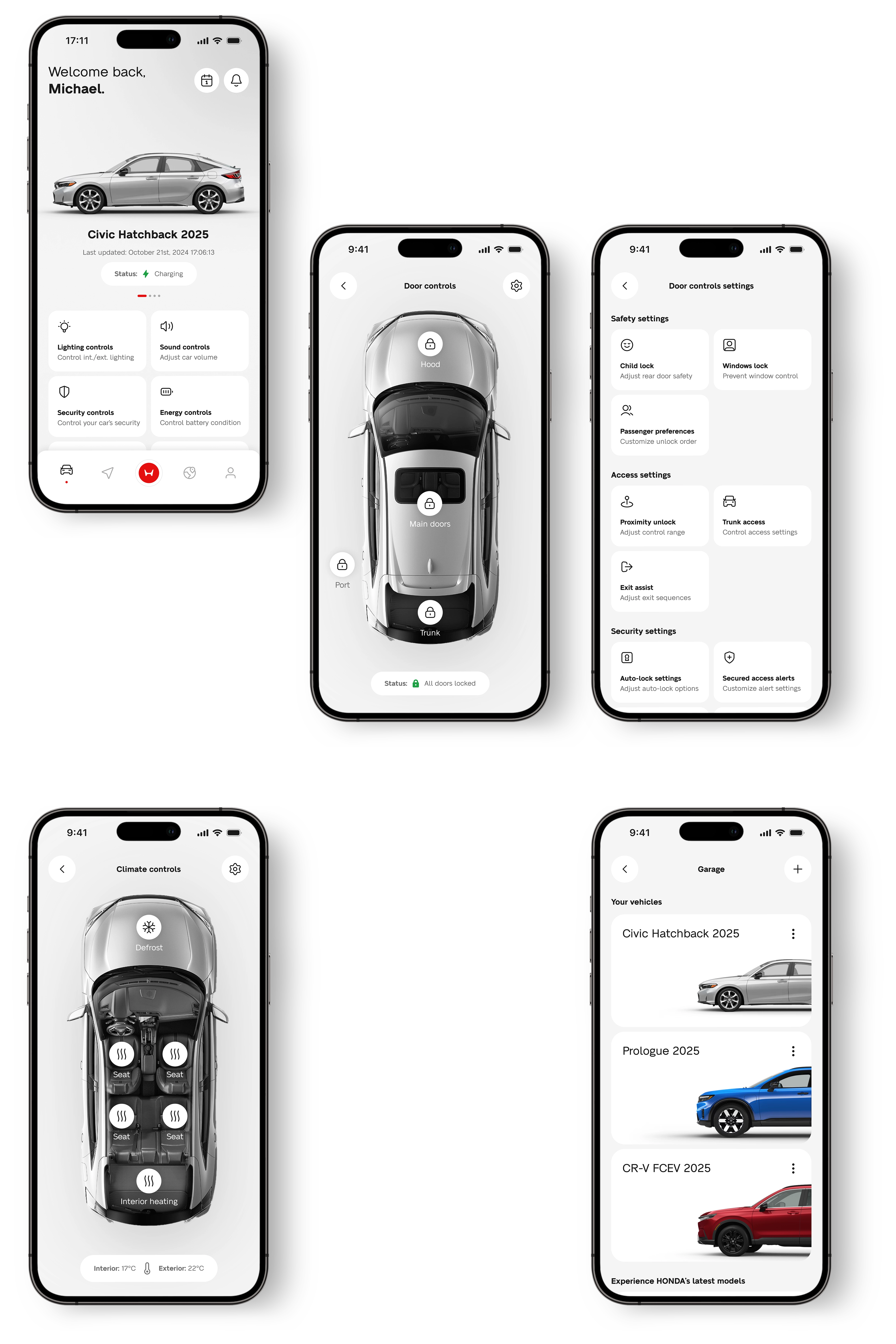
Pre-Trip controls that make vehicle readiness instant and intuitive
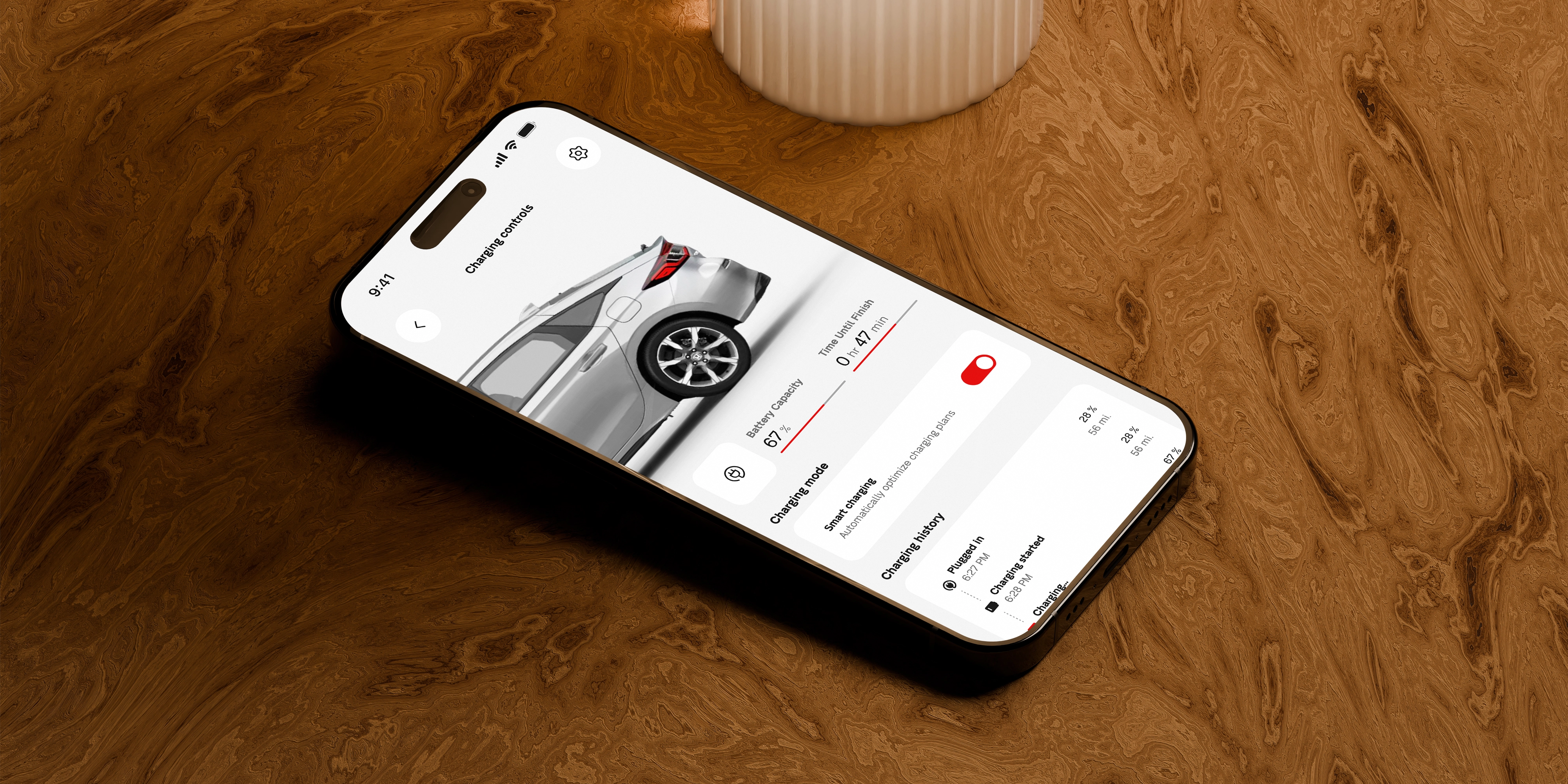
Charging redesigned: clearer battery health and real-time progress
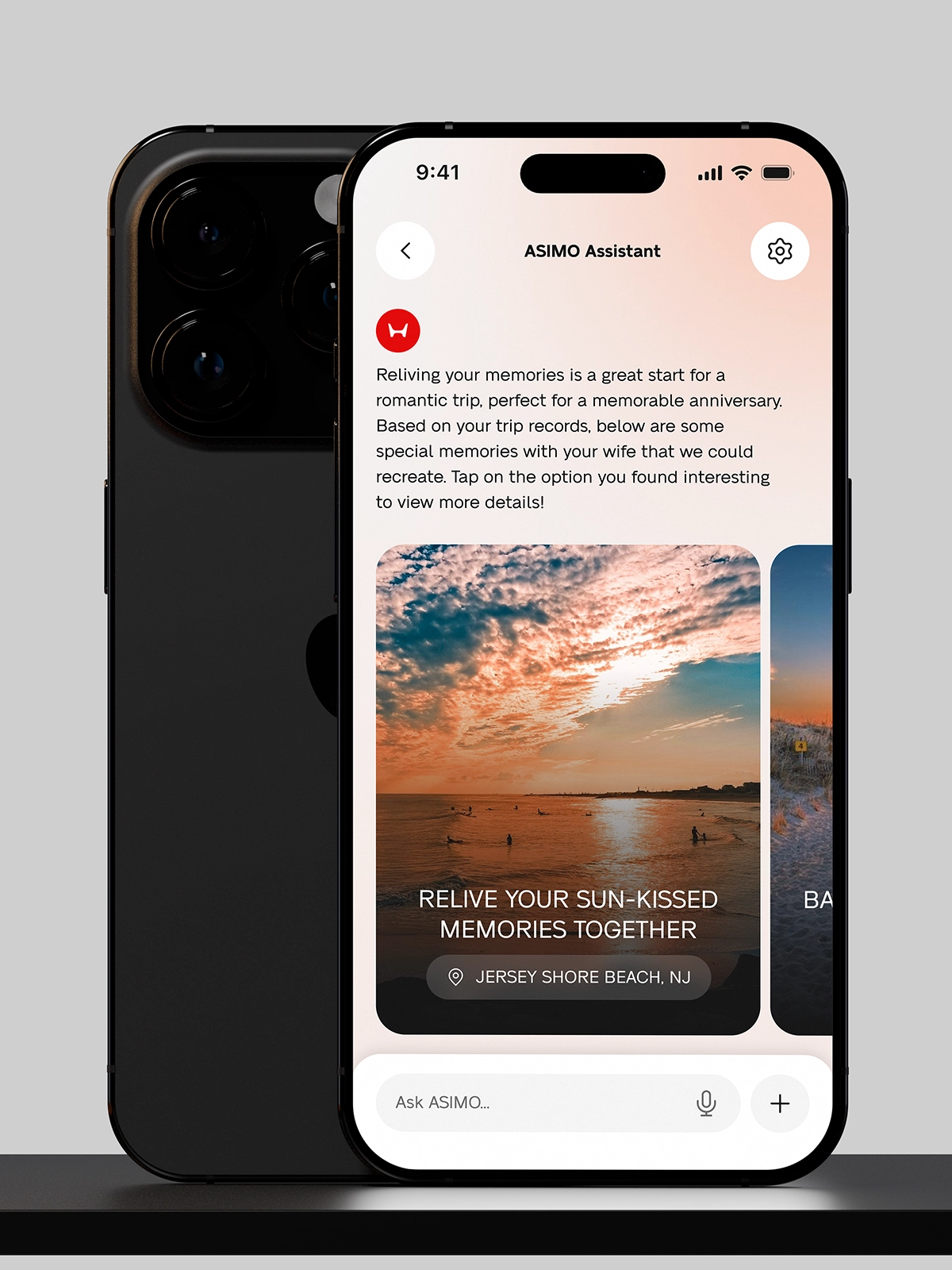
(ASIMO Assistant in the pre-trip experience)
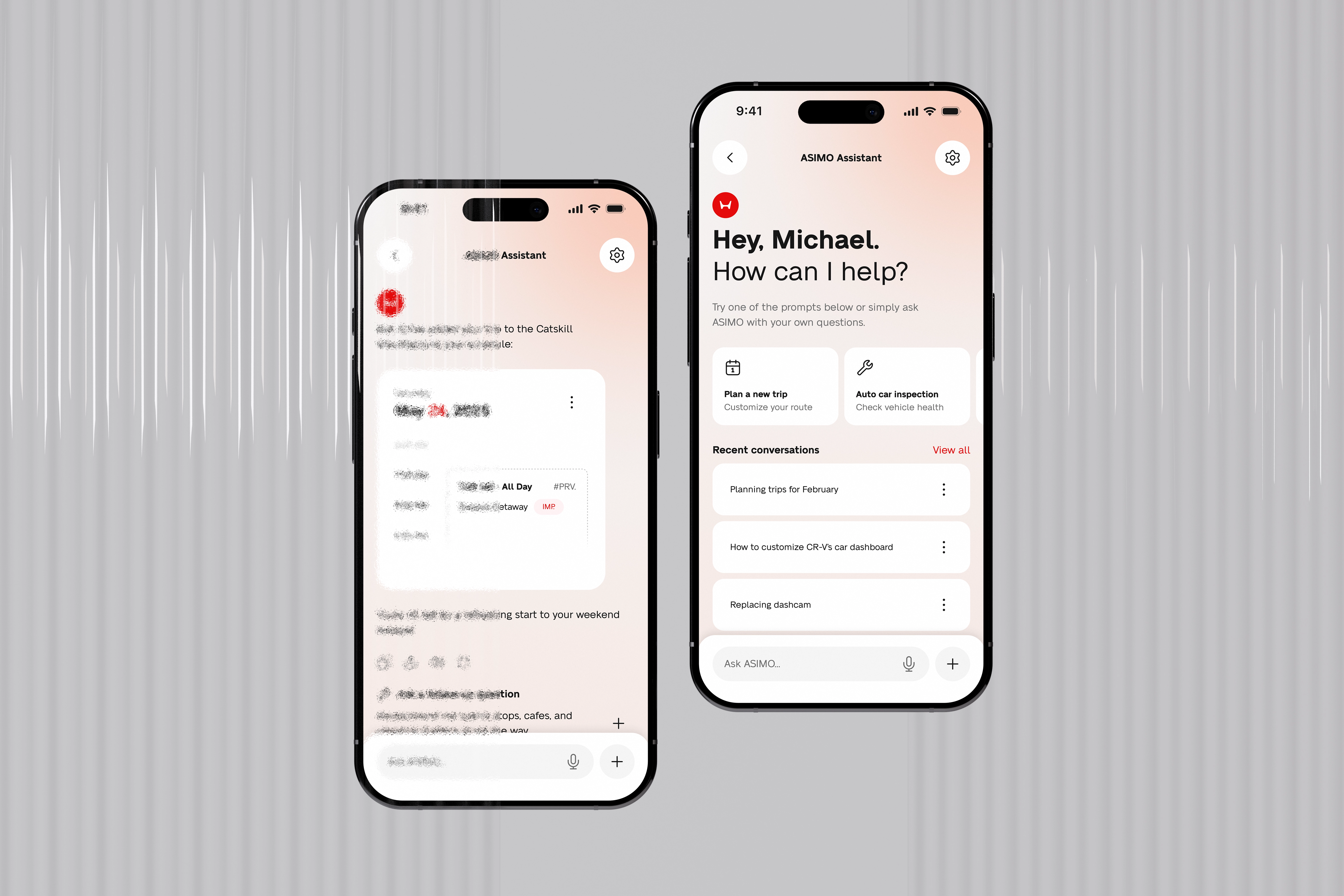
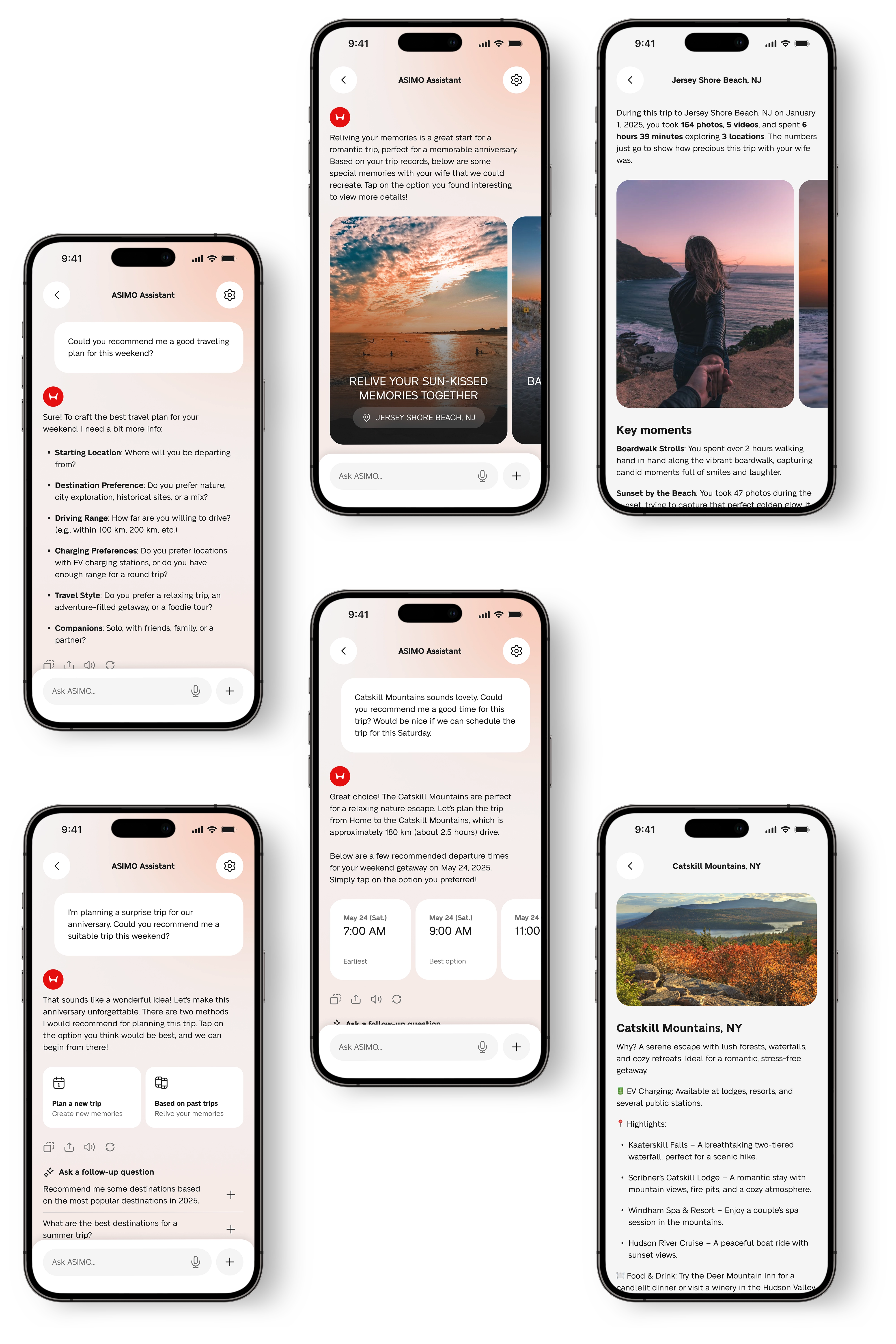
Within the Pre-Trip phase, ASIMO Assistant plays two roles that work in tandem:

1) Smart Controller — automatically optimizes vehicle readiness, from charging cycles to cabin conditioning, so users gain the benefits without needing technical know-how.

2) Smart Planner — helps users shape trips in flexible ways, from revisiting past journeys and memories to refining routes for efficiency and convenience. By using past trip data as a reference point, ASIMO reinforces ConnectX’s positioning—turning what users have experienced into new ideas, plans, and opportunities.

By embedding ASIMO directly into the Pre-Trip flow, ConnectX transforms routine preparation into a more personal and intelligent experience—one that reflects Honda’s vision for connected mobility and establishes a clear point of differentiation against competing ecosystems.
ASIMO Assistant, integrated into the ConnectX experience
ASIMO Assistant as Smart Planner and Smart Controller—raising capability and ease
LRM-powered personalization, grounded in past trips and preferences
(Synchronization mode and voice control during mid-trip)
The Mid-Trip phase is often the most underdeveloped part of many connected ecosystems, largely due to its safety constraints and regulatory complexity—making it a meaningful opportunity for ConnectX to differentiate.

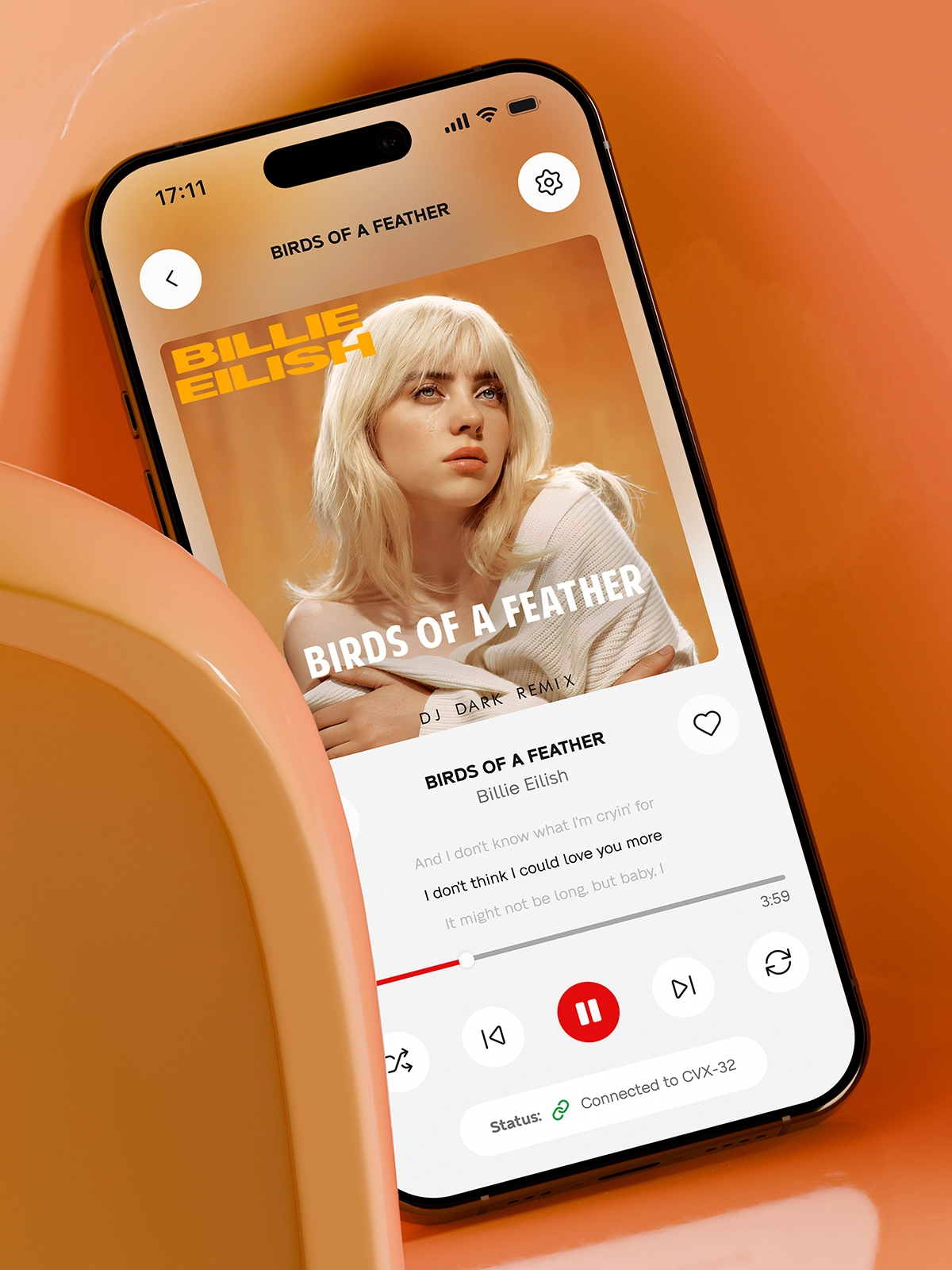
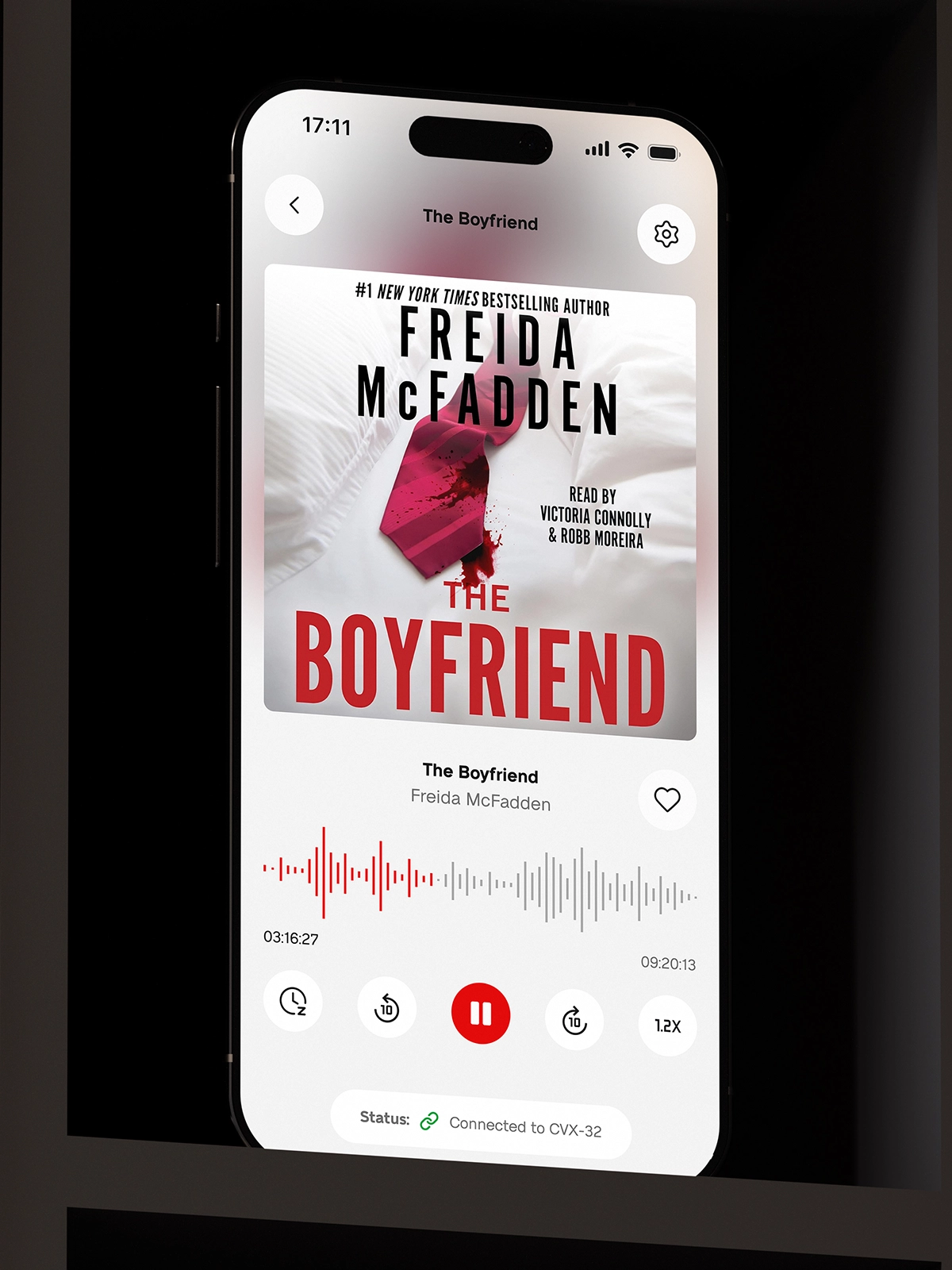
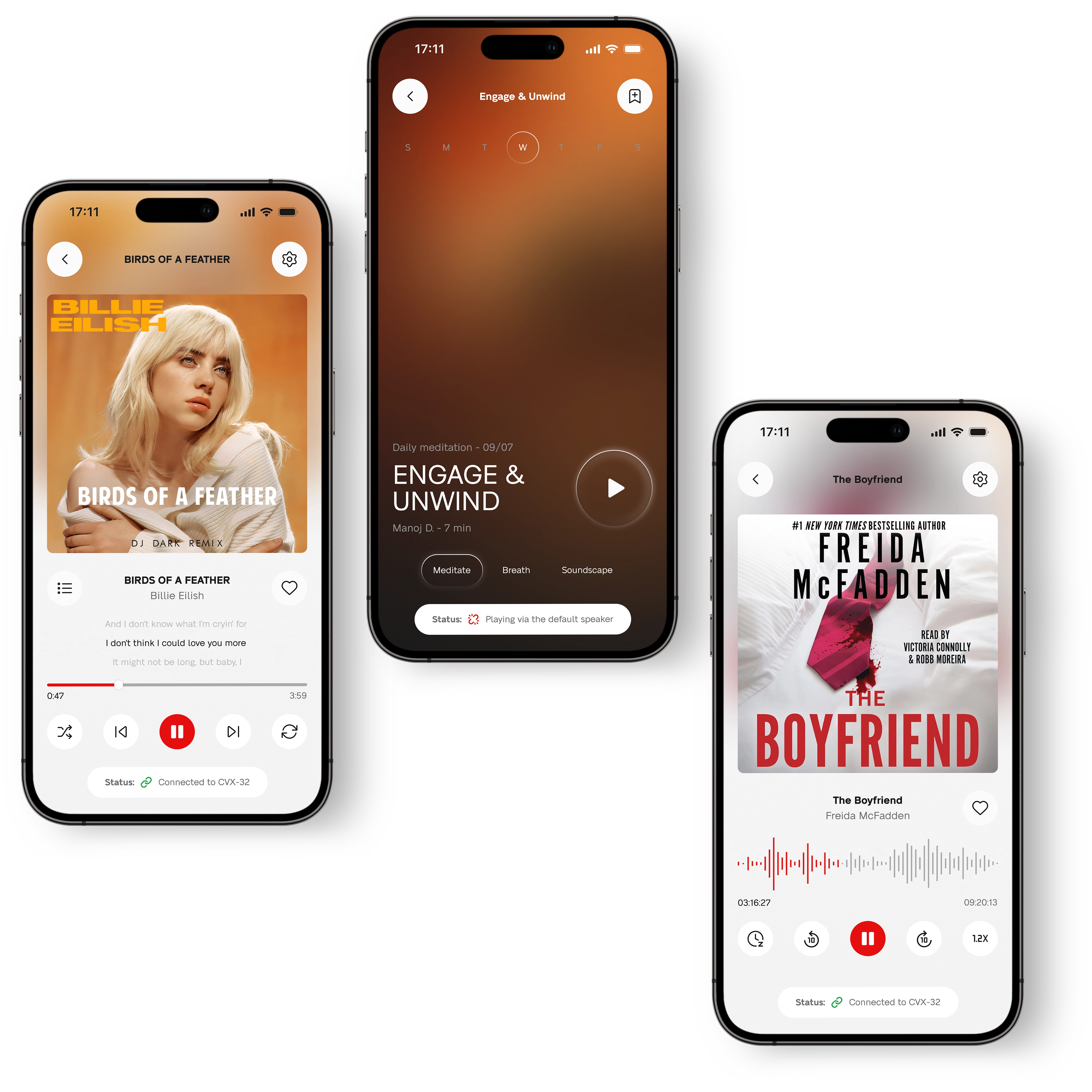
Because Mid-Trip demands a fundamentally different approach from Pre-Trip, we introduced a dedicated operating mode called Synchronization. This smart connectivity layer turns the user’s smartphone or tablet into an extension of any Honda 0 and connected model, enabling safer, more usable interactions while driving.

Through in-vehicle connectivity, ConnectX links the device with the vehicle’s infotainment and dashboard systems, coordinating capabilities across speakers, sensors, and cameras. Additional functions can be accessed through the user’s device while the infotainment remains focused on critical driving surfaces. In Synchronization Mode, voice and sound become the primary interaction model—with touch as a fallback—reducing cognitive load and supporting a regulation-conscious experience aligned with GSR, JAMA, and NHTSA guidance. This foundation not only improves comfort and safety today, but also supports Honda’s longer-term roadmap toward smarter driving and higher levels of autonomy.
Synchronization Mode: expanded hands-free functions while driving
(Post-Trip analytics — unlocking the full power of Honda 0)
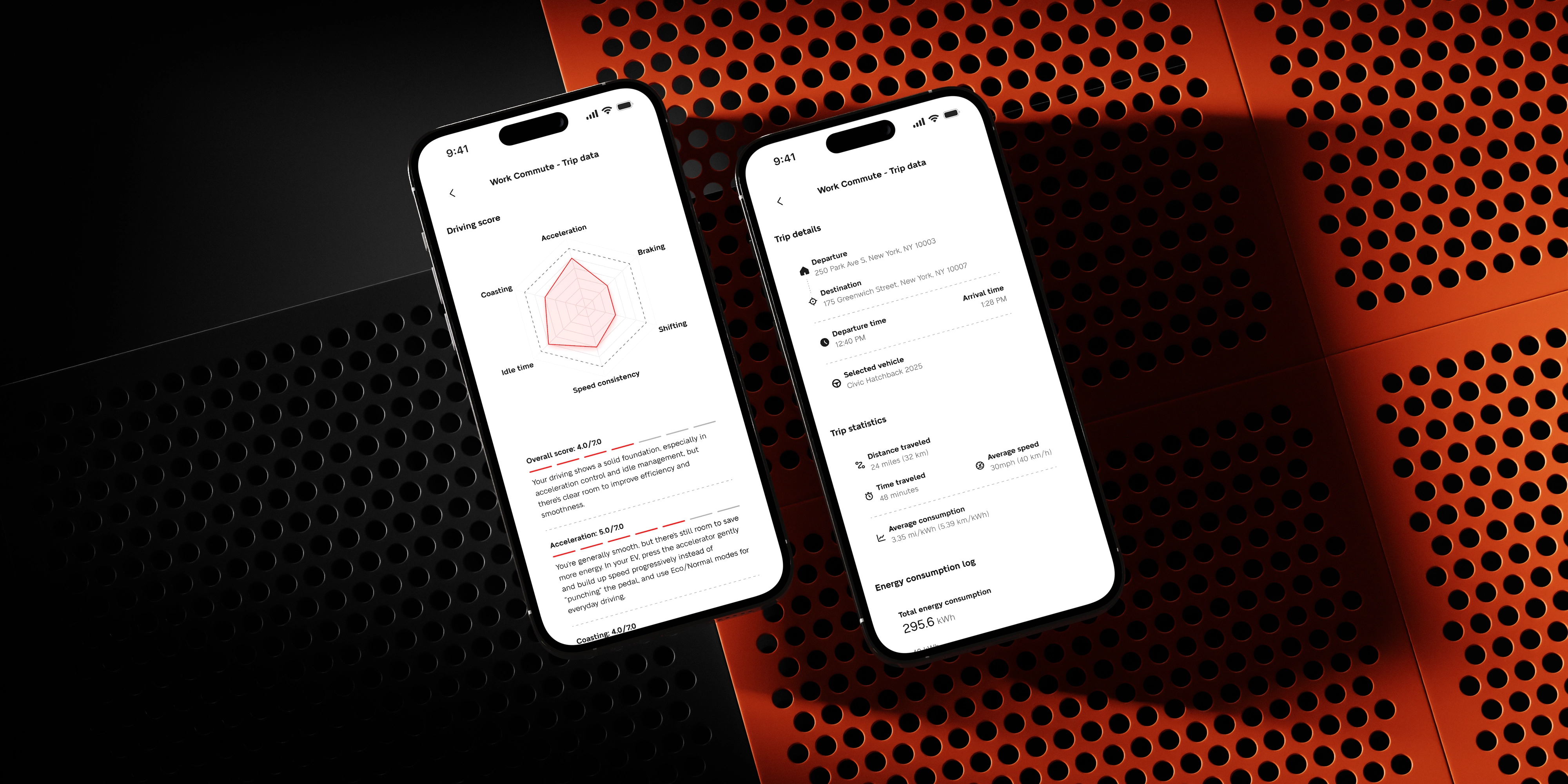
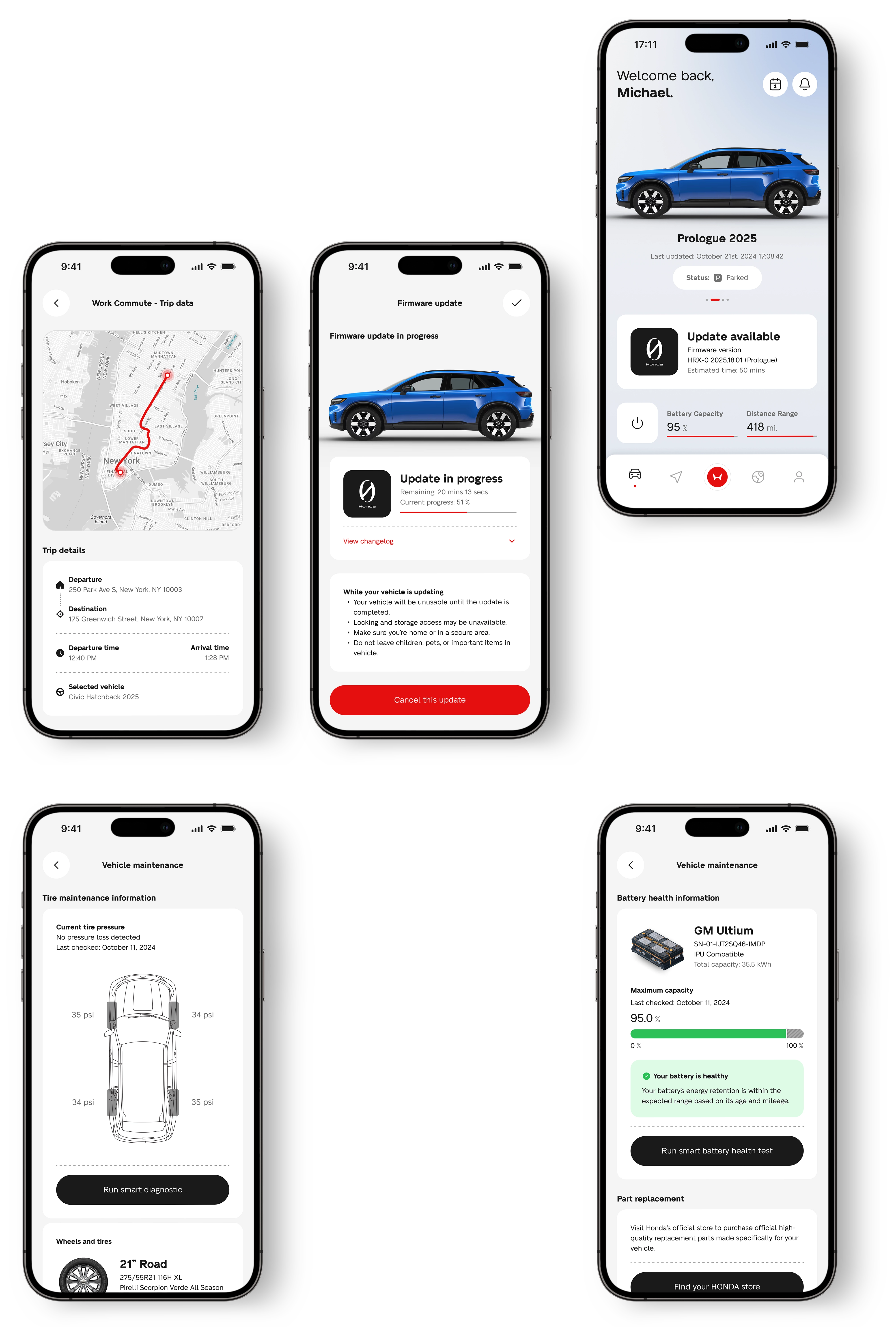
In the Post-Trip phase, our focus is on giving users actionable insights drawn from their recent journeys. The analytics provide a detailed snapshot of each trip—covering travel costs, driving style, and real-time vehicle conditions—helping users anticipate maintenance needs and make timely decisions about their car’s care.
Vehicle health and firmware updates—clear, simple, and actionable
(Drawing users deeper into the Honda world)
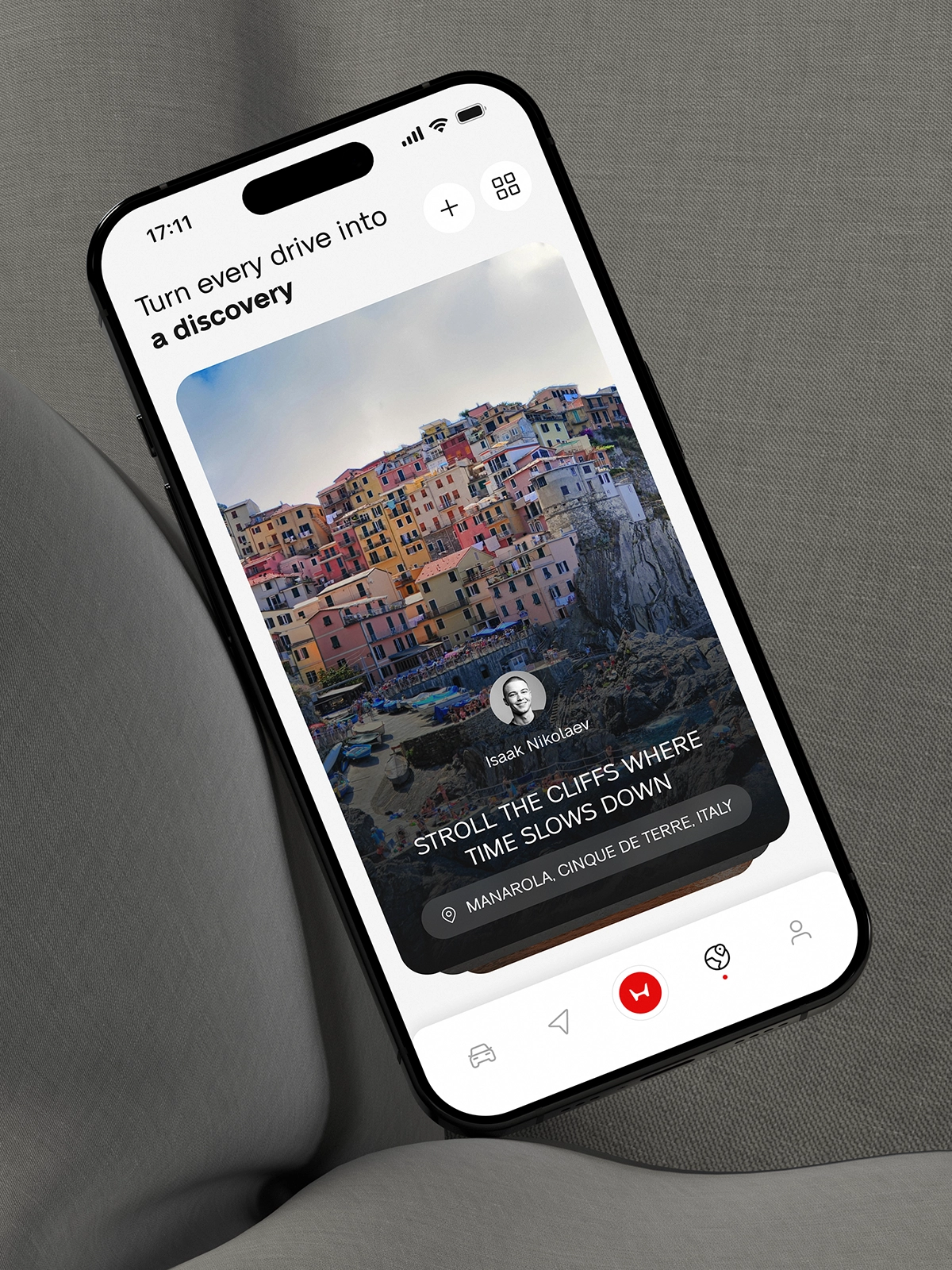
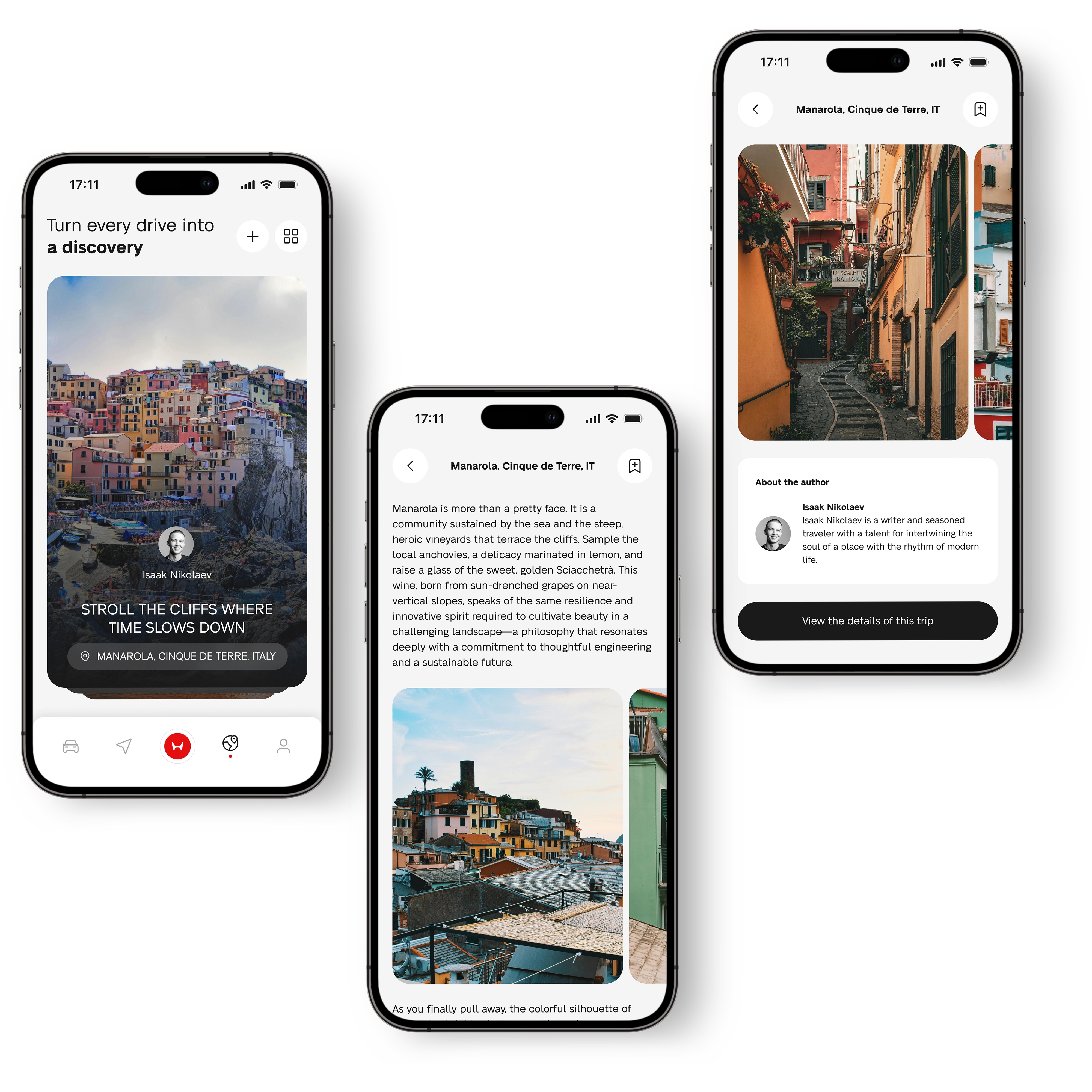
Outside the three primary phases, ConnectX offers features designed to inspire exploration and strengthen brand engagement. Users can browse curated trip reports from trusted Honda correspondents around the globe, discovering new destinations and travel ideas to enrich their Honda life.

Additionally, interactive simulations let users digitally experience other Honda models, keeping interest in the brand vibrant and encouraging ongoing connection with the Honda ecosystem.
Trip discovery designed to inspire what’s next
Curated trip stories from Honda partners, built for exploration
Testing product-market reception
(Quantifying brand lift and willingness to pay)
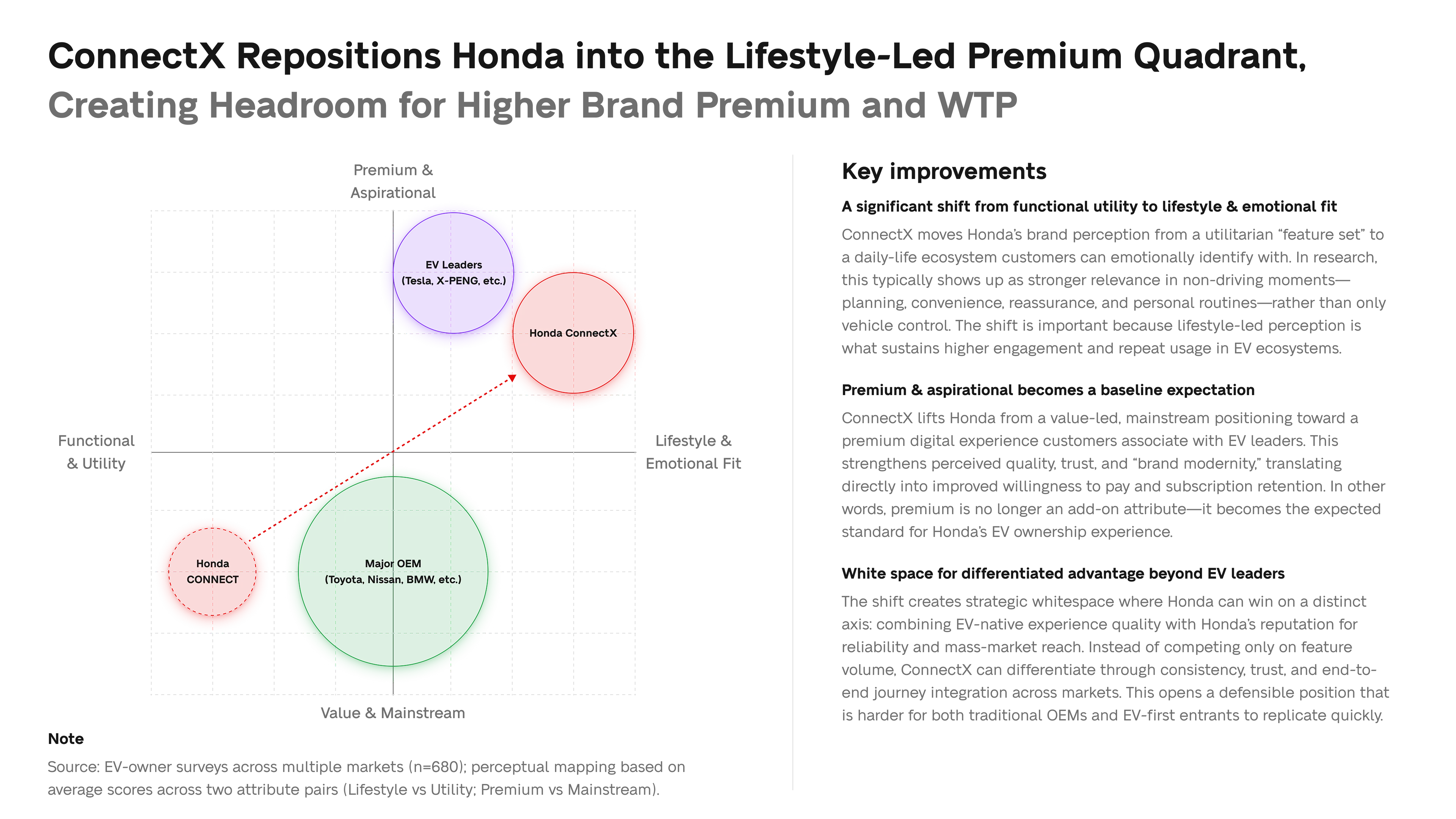
At CES 2025, in partnership with multiple Honda teams, we validated early product-market reception through a blended approach of live observation, quantitative surveys, and in-depth interviews. The results showed measurable improvement across key dimensions—most notably in brand sentiment, which shifted toward a more lifestyle-led perception, and in brand premium, strengthening perceived value and translating into a materially higher willingness to pay (approximately 3× versus the baseline).

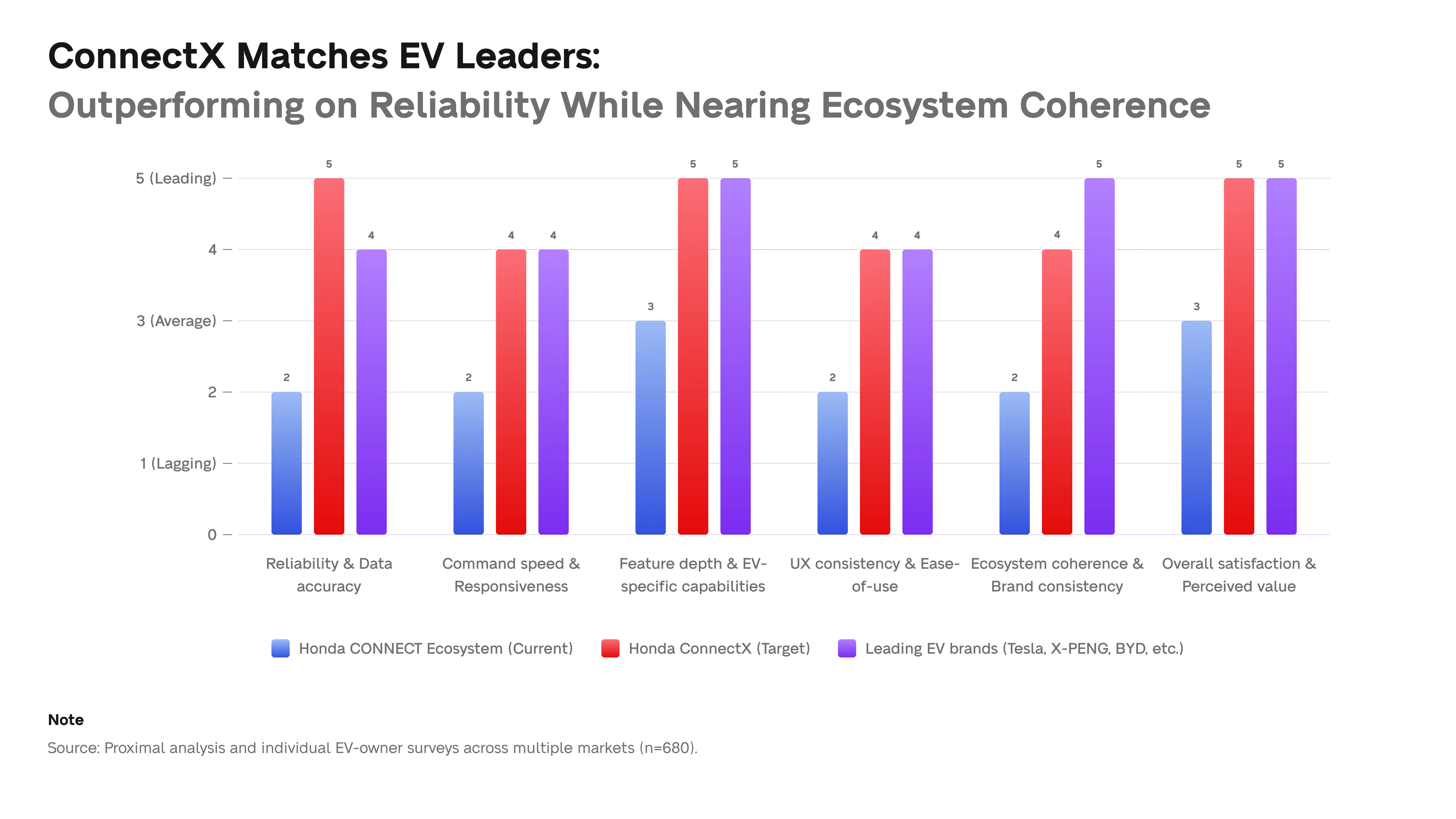
We also observed meaningful gains across major customer decision drivers—bringing ConnectX’s perceived experience closer to the standards set by leading EV brands.
In-depth interview insights—direct user feedback that shaped the concept
CES 2025 validation indicates ConnectX shifts Honda’s brand perception toward a lifestyle-led, premium EV position, strengthening brand premium and willingness to pay.
ConnectX consolidates Honda’s connected ecosystem into an EV-first platform that reaches EV-leader parity and outperforms on reliability.
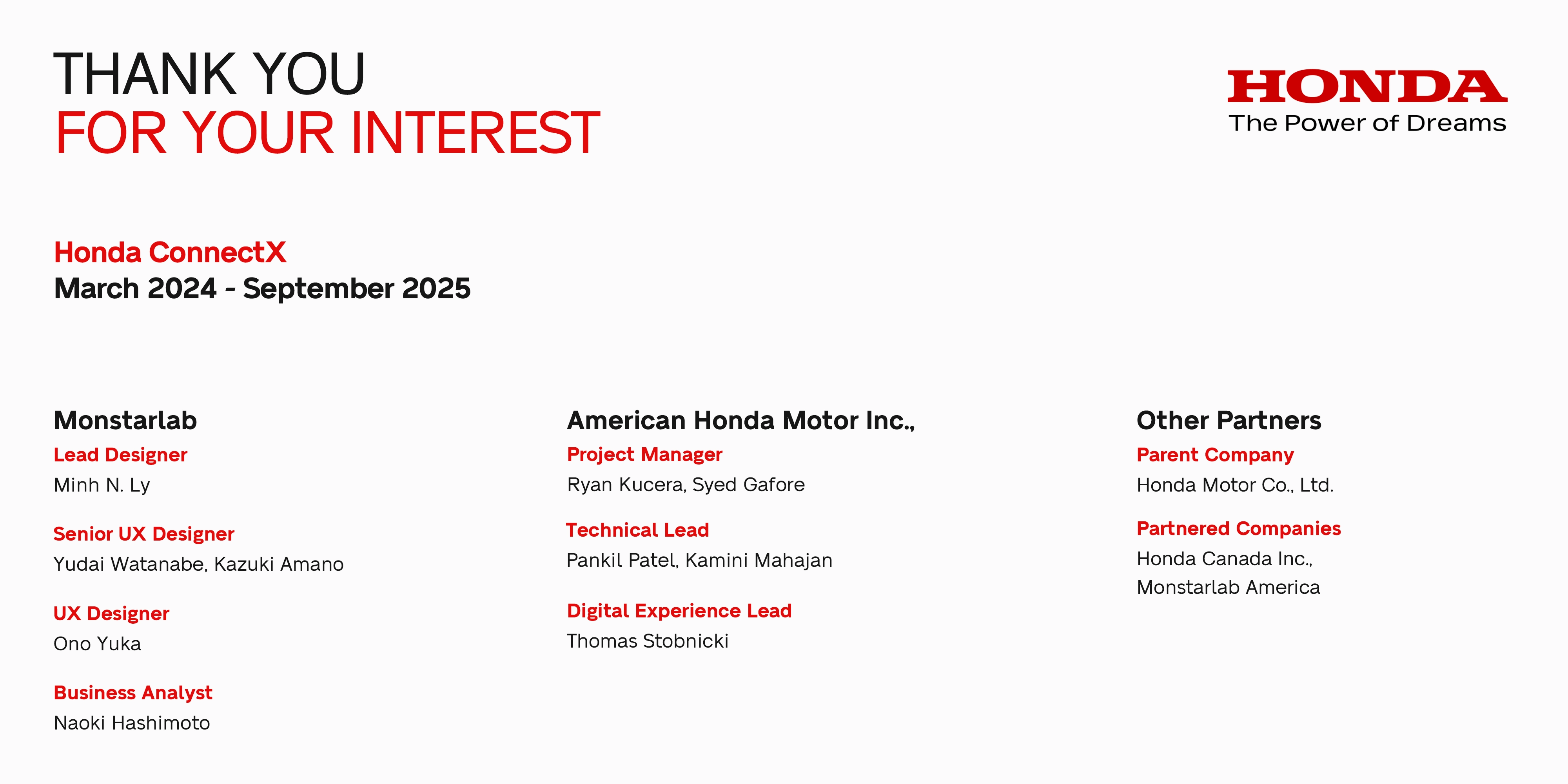
A big thumbs-up to the team behind Honda ConnectX
(Credits)
Great products are never built in isolation—behind every successful launch is a team of dedicated individuals bringing their expertise, passion, and collaboration to the table. I’m deeply grateful to every project member who contributed to the creation of Honda ConnectX. This achievement would not have been possible without your commitment and vision.
Project team roster: Honoring the contributors who helped shape Honda ConnectX
Next project
NEXUS - Employee eXperience: creating the next generation of hospitality
strategy
PRODUCT
BRAND
EXPERIENCE